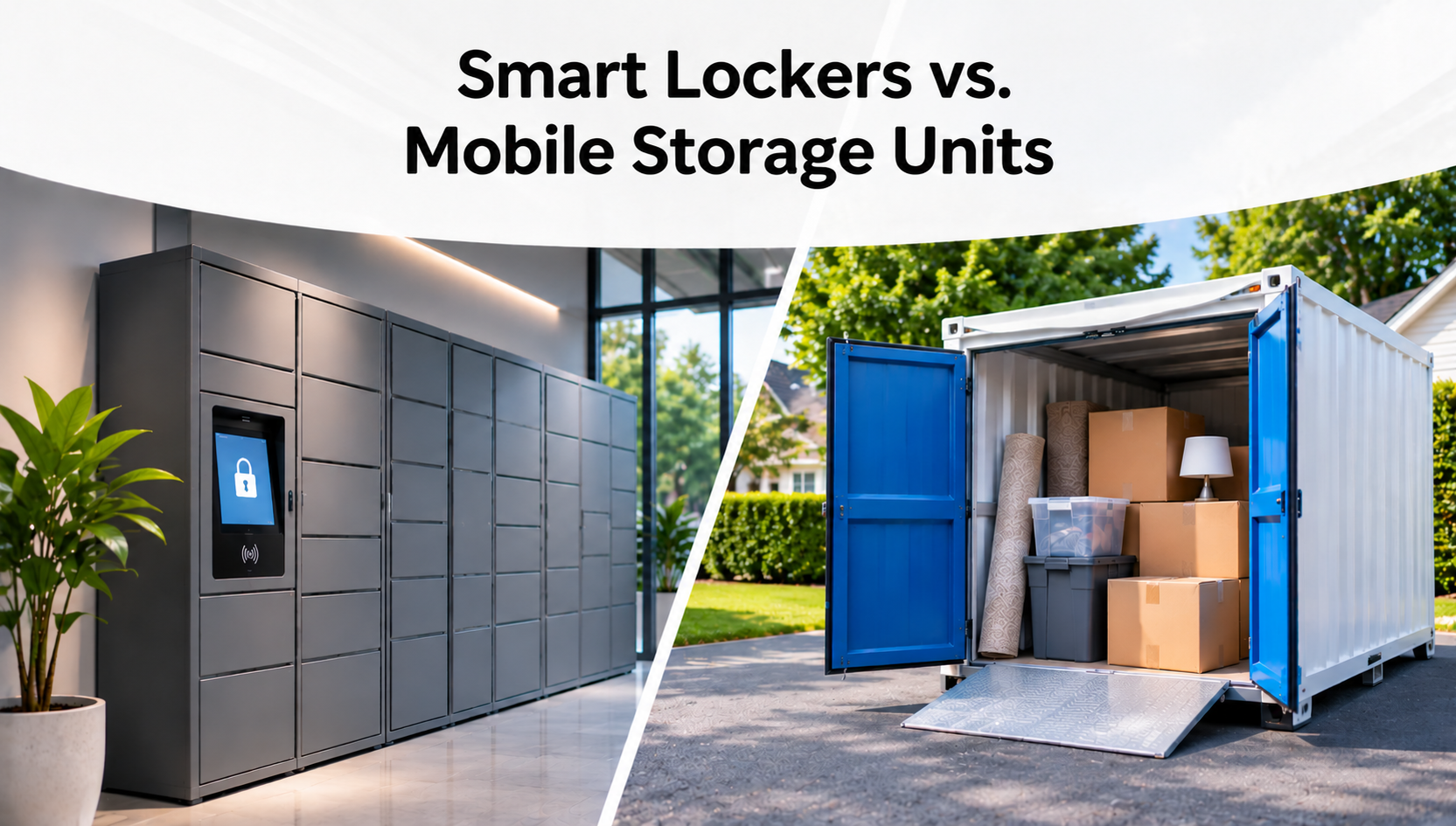
Choosing the right storage solution depends on what you need to store, how frequently you need access, how much space your belongings require, and whether your storage arrangement needs to move with you. Smart lockers and mobile storage units offer two different approaches to managing personal and business belongings. Both provide convenient ways to keep items outside your primary living or working space, but their physical design, accessibility, capacity, and intended uses are considerably different.
Smart lockers use electronic access systems to manage individual compartments. Depending on the provider, users may open them through a mobile application, PIN, QR code, RFID card, or another approved credential. Mobile storage units, on the other hand, are portable containers that can be delivered to a home or business, loaded at the customer's convenience, and transported to another location or storage facility.
The right choice depends on the scale and purpose of your storage requirements. A smart locker may be more practical for smaller belongings that need convenient collection and controlled access, while a mobile storage container can accommodate larger items, furniture, equipment, and household contents during a move or renovation.
This guide compares smart lockers and mobile storage units across capacity, convenience, security, accessibility, costs, and insurance considerations to help you understand which arrangement is better suited to your situation.
Key Takeaways
- Smart lockers are electronically managed storage compartments that provide controlled access through digital authentication methods.
- Mobile storage units are portable containers designed to accommodate larger belongings, furniture, household contents, and business equipment.
- Smart lockers are generally more suitable for smaller items, frequent collection, and applications that require controlled access and transaction records.
- Mobile storage containers are useful for relocations, renovation projects, business inventory, and situations requiring temporary storage at different locations.
- Digital access features do not automatically guarantee complete security, and mobile containers still require appropriate locking, handling, and protection.
- Storage costs depend on compartment or container size, rental duration, location, access arrangements, delivery, transportation, and additional services.
- Before choosing insurance, confirm whether your specific storage arrangement and belongings qualify under the policy terms.
Pro Tip
Estimate the total value and physical size of your belongings before choosing a storage arrangement. Do not select a smart locker simply because it offers convenient digital access if your belongings require considerably more space. Similarly, avoid paying for a large mobile storage container when you only need somewhere to keep a few small items. Consider access frequency, storage duration, transportation requirements, and applicable insurance before making your decision.
What Are Smart Storage Lockers?
Smart storage lockers are electronically controlled compartments that use digital authentication and management systems to provide access to stored belongings. Unlike traditional lockers that generally rely on physical keys or basic combination locks, smart lockers can connect individual compartments to software that manages user permissions, availability, access activity, and notifications.
Depending on the system, a user may receive a temporary access code, scan a QR code, use an RFID card, or authenticate through a mobile application. Once the system verifies the user's permissions, the assigned compartment can be unlocked electronically.
Some smart lockers are designed for personal belongings, while others are intended for parcel collection, workplace equipment, or business inventory exchanges. Therefore, not every smart locker is suitable for long-term personal storage. Check the intended purpose, compartment dimensions, rental terms, and access restrictions before using one for your belongings.
How Do Smart Lockers Work?
Smart lockers combine physical compartments with electronic locks and access management software. The exact process depends on the system installed by the operator, but most arrangements follow a similar sequence.
- Compartment assignment: The operator assigns an available locker or allows the user to select an eligible compartment.
- User authentication: The user verifies their identity through an approved access method, such as a PIN, QR code, RFID credential, or mobile application.
- Electronic unlocking: The system authorizes access and releases the assigned compartment.
- Storage or collection: The user places belongings inside or retrieves previously stored property.
- Activity recording: Depending on the platform, the system can record access activity and send confirmation or notification messages.
These features make smart lockers useful in environments where multiple people need controlled access to individual compartments without requiring an employee to manage every collection or retrieval. However, their suitability still depends on the amount and type of property being stored.
What Are Mobile Storage Units?
Mobile storage units are portable containers used to store belongings during relocations, renovations, business operations, and other situations requiring temporary or flexible storage. Unlike fixed storage compartments, these units are designed to be transported between locations using specialized delivery and transportation arrangements.
A typical mobile storage arrangement begins with a container provider delivering a unit to the customer's property or another agreed location. The customer loads furniture, boxes, equipment, or other eligible belongings at their own pace. Once loading is complete, the provider can collect the container and transport it to a storage facility or another destination, depending on the service agreement.
Portable containers are available in different dimensions and configurations. Their capacity makes them useful for storing larger belongings that cannot fit inside conventional locker compartments. However, the available size, delivery arrangements, weight restrictions, storage conditions, and transportation options depend on the individual container provider.
How Does Mobile Storage Work?
Mobile storage generally involves several stages, from arranging delivery to retrieving the belongings at the final destination.
- Delivery: The container provider delivers a portable storage unit to the agreed location, subject to site access and delivery requirements.
- Loading: The customer packs and secures belongings inside the container according to the provider's loading and weight requirements.
- Collection: Once loading is complete, the provider collects the container if transportation or off-site storage has been arranged.
- Transportation or storage: The container may be transported to another property or kept at a designated storage facility.
- Retrieval: The container is made available at the agreed destination or returned to the customer for unloading, depending on the arrangement.
Mobile storage can reduce the need to transport individual belongings to a conventional storage facility yourself. For a closer look at container preparation, read these tips for packing a storage container before arranging delivery.
Smart Lockers vs. Mobile Storage Units: Key Differences
Although both options provide additional storage space, smart lockers and mobile containers are designed around different requirements. Smart lockers prioritize electronically managed compartment access, while mobile storage units prioritize physical capacity, flexibility, and transportation.
The following comparison highlights the main differences to consider when evaluating these storage arrangements.
| Comparison Factor |
Smart Lockers |
Mobile Storage Units |
| Physical design |
Fixed compartments with electronically controlled locks and access software. |
Portable containers designed to be delivered, loaded, collected, and transported. |
| Storage capacity |
Generally limited to the dimensions of individual compartments. |
Typically accommodates larger items, furniture, boxes, and business equipment. |
| Access methods |
May include PINs, QR codes, RFID cards, or mobile applications. |
Usually accessed through physical doors and an appropriate lock or security system. |
| Mobility |
Generally installed at a fixed location. |
Designed to be moved between locations through an arranged transportation service. |
| Typical applications |
Small personal belongings, parcel collection, equipment, and controlled item exchanges. |
Relocations, renovation projects, furniture, household contents, and business inventory. |
| Transportation |
Users generally transport their belongings to and from the locker location themselves. |
The container provider can arrange collection, transportation, and delivery. |
| Access convenience |
Can offer quick, controlled access, subject to facility and system availability. |
Convenient for loading at your property, but retrieval depends on the container's location and rental agreement. |
| Cost considerations |
Compartment size, rental duration, location, and access features. |
Container size, rental period, delivery, collection, transportation, and storage fees. |
Storage Capacity: Which Option Holds More Belongings?
Storage capacity is one of the clearest differences between smart lockers and mobile storage containers. Although a smart locker system can consist of numerous individual compartments, each compartment usually has defined dimensions that restrict the size and type of belongings it can accommodate.
Mobile storage containers offer a larger physical storage area and are generally better suited to belongings that cannot fit into smaller compartments. Furniture, mattresses, packed boxes, appliances, business inventory, and construction equipment may require the additional space that a portable container provides.
When Smart Locker Capacity Is Enough
Smart lockers can be suitable when you only need to store a limited quantity of smaller belongings. Documents, personal accessories, compact equipment, small tools, and parcel deliveries are examples of items that may fit within an appropriately sized compartment.
However, always review the internal dimensions, weight restrictions, and permitted contents. The availability of several compartments does not necessarily mean a smart locker installation can accommodate large household belongings or bulky equipment.
When a Mobile Storage Container Makes More Sense
A mobile container is generally more practical when you need to store a substantial volume of property. A household relocation, office renovation, commercial inventory arrangement, or temporary building project can involve items that would be impractical to divide between small locker compartments.
Before ordering a container, calculate the approximate volume of your belongings and compare it with the provider's available dimensions and loading restrictions. Read the advantages of using a mobile storage container to understand where portable storage can fit into different moving and storage situations.
Accessibility and Convenience: How Do They Compare?
Convenience means different things depending on how you intend to use your storage space. Someone collecting a small package may prefer the quick access of a smart locker, while someone moving an entire household may value having a container delivered directly to their property.
Smart Locker Accessibility
Smart lockers can make collecting belongings straightforward through electronic authentication. Users may receive a unique access code or notification and retrieve their items without arranging an appointment with an employee. This can be useful when lockers are installed in convenient locations and the operator allows access during suitable hours.
However, digital access does not necessarily mean unrestricted access. A facility may impose operating hours, rental periods, access permissions, or collection deadlines. Some systems may also depend on network connectivity, electronic hardware, or mobile authentication, so it is worth checking how access is handled during outages or technical problems.
Mobile Storage Accessibility
Mobile storage containers provide a different form of convenience because the container can be delivered to your home or business. This can reduce the need to transport belongings to a storage facility yourself. You can load items gradually, organize the contents, and arrange collection when the container is ready.
Once the container has been collected and moved to an off-site facility, immediate access may require additional arrangements with the provider. Consider how frequently you need your belongings and whether the provider allows access at its storage location before signing a rental agreement.
Security Features: Are Smart Lockers Safer Than Mobile Storage Units?
Security should be evaluated by looking at the entire storage arrangement rather than focusing on one locking feature. Smart lockers and mobile storage containers use different security approaches, and the level of protection depends on the hardware, facility, operator, access procedures, and handling practices.
Smart Locker Security Features
Smart locker systems can provide several access-control capabilities that are not available with basic mechanical lockers. Depending on the platform, features may include:
- Individual user authentication through PINs, QR codes, mobile credentials, or RFID cards.
- Temporary or restricted access permissions for authorized users.
- Electronic records showing when compartments were accessed, where the system supports activity logging.
- Remote administration and user permission management on supported platforms.
- Notifications and access alerts where included in the locker system.
These features can improve access management and accountability, but they do not make a locker immune to theft, unauthorized access, hardware failure, or damage. Users should check how credentials are protected, how lost access is handled, and what security measures exist around the locker installation itself.
Mobile Storage Container Security Features
Mobile containers generally rely on physical security measures, including strong doors, locking mechanisms, padlocks, and secure storage locations. The container's construction and the provider's transportation procedures also influence how well the belongings are protected.
Before selecting a provider, ask what locking equipment is supplied, whether the container is kept at a monitored storage facility, how access is controlled, and what happens if the container is moved or damaged. A sturdy container is useful, but secure handling and proper loading are also necessary.
Neither digital access controls nor physical locks provide a substitute for appropriate contents protection. Understand the separate responsibilities of the storage operator, transportation provider, and insurance provider before deciding how to protect valuable belongings.
Which Storage Option Is Better for Homeowners?
Homeowners often need temporary storage when moving, renovating, downsizing, or reorganizing their living spaces. The amount and type of property involved should determine whether a smart locker or mobile container is suitable.
A smart locker may work for selected small belongings that need to be stored separately and collected conveniently. However, a locker compartment is unlikely to accommodate the larger furniture, appliances, boxes, and household contents associated with a full home relocation.
A mobile storage container can be more practical during a renovation or household move because it provides a larger loading area at the property. Furniture, cartons, seasonal items, and other household belongings can be packed together and transported according to the agreed schedule.
Consider the expected storage period, container placement requirements, available driveway or parking space, delivery schedule, and whether you need access while the container is off-site. These details can influence the overall convenience and cost more than the storage format alone.
Which Option Is Better for Businesses?
Businesses may need storage for equipment, supplies, documents, retail inventory, tools, or materials used across different locations. The right arrangement depends on whether the priority is controlled access to smaller items or additional space for larger quantities of property.
When Smart Lockers Work for Business Needs
Smart lockers can be useful in workplaces where employees, contractors, or customers need to collect or return smaller items. A business may use them to manage tools, devices, packages, personal belongings, or equipment assigned to authorized users.
For example, an organization can provide controlled access to equipment without requiring a manager to supervise every handover. Depending on the software, administrators may also be able to review locker activity and manage access permissions centrally.
When Mobile Storage Works for Business Needs
Mobile storage containers are more appropriate when a business needs space for larger inventory quantities, construction equipment, office furniture, commercial supplies, or materials used during temporary projects.
They can also be useful when businesses need temporary storage at a worksite or during a relocation. Having a container delivered to the premises can reduce the need for multiple trips to a fixed storage facility, subject to the provider's delivery and placement requirements.
Businesses using portable containers should also plan for loading procedures, employee access, inventory documentation, transport schedules, and insurance requirements. Review the relevant steps for adding a mobile storage container to an insurance policy before arranging a move or temporary storage period.
What Are the Cost Differences Between Smart Lockers and Mobile Storage?
The cost of smart lockers and mobile storage units depends on the provider, location, available capacity, rental duration, and additional services. Neither option has one universal price, so compare the complete cost of the arrangement instead of looking only at its advertised monthly or rental rate.
Smart Locker Costs
Smart locker charges may depend on compartment dimensions, storage duration, location, access features, and whether the locker is used for personal storage, parcel collection, or another application. Some systems charge by rental period, while others are included within a wider service arrangement.
Before committing, confirm whether the quoted price includes access credentials, extended access hours, notifications, and any additional service charges. Also ask about fees for lost credentials, overdue collection, or extending the rental period.
Mobile Storage Costs
Mobile storage costs can include container rental, delivery, collection, transportation, off-site storage, and extended rental charges. The total amount may vary depending on how far the container needs to travel, how long it remains in storage, and whether multiple containers are required.
Ask the provider for an itemized quotation and check whether additional delivery attempts, extended storage, or access to an off-site container involve extra charges. Compare the full rental cost with the value of the convenience and space being provided.
Do Smart Lockers and Mobile Storage Units Require Insurance?
Both storage arrangements can involve financial risks if belongings are damaged, stolen, or affected by an unexpected covered event. The presence of electronic locks, access records, security cameras, or a sturdy container does not automatically protect the financial value of the property stored inside.
Before purchasing insurance, identify who owns the stored contents, where the property will be located, how long it will remain there, and whether transportation is involved. The insurance policy should specifically apply to the storage arrangement and the eligible property being insured.
Insurance Considerations for Smart Lockers
Do not assume that a standard storage unit insurance policy automatically applies to every smart locker system. Some smart lockers are used for parcel handovers, workplace equipment, or short-term collections rather than conventional self-storage. Their physical location, ownership structure, rental arrangement, and contents eligibility can affect whether a particular policy applies.
Confirm the eligibility of the specific locker and the stored property with the insurance provider before purchasing coverage. Review the covered causes of loss, exclusions, limits, deductibles, and any requirements relating to the insured storage address.
Insurance Considerations for Mobile Storage Containers
Mobile storage containers can involve additional risks because the container may remain at your property, travel between locations, or be kept inside an off-site storage facility. Insurance should be reviewed for each relevant stage of the arrangement rather than assuming that protection automatically follows the belongings everywhere.
Check whether the policy covers eligible contents while the container is stationary, during transportation, and at the designated storage location. Also distinguish insurance for the belongings inside the container from any separate protection for the rental container itself. For more information, see what happens if a mobile storage container is damaged while moving.
How Discount Storage Insurance Supports Storage Protection
Choosing a storage arrangement and arranging insurance are two separate decisions. The storage operator provides the physical space or container, while an insurance provider can offer financial protection for eligible belongings against specified covered events.
Discount Storage Insurance specializes in insurance for eligible belongings kept in self-storage units and portable mobile storage containers. The company provides dedicated insurance options rather than renting storage spaces, operating smart locker systems, or delivering portable containers.
Self-Storage Insurance for Eligible Stored Contents
Customers storing belongings in qualifying self-storage units can explore the self-storage insurance program offered by Discount Storage Insurance. It is designed to provide contents protection against specified covered events, subject to the policy's conditions, coverage limits, deductibles, and exclusions.
Before enrolling, review the policy terms and confirm that the storage location and all intended contents meet the eligibility requirements. If you are considering a smart locker rather than a conventional self-storage unit, obtain confirmation that the particular arrangement qualifies before relying on coverage.
Mobile Storage Container Insurance
For customers using qualifying portable storage containers, Discount Storage Insurance also offers a dedicated mobile storage container insurance program. This option is designed for eligible contents in portable containers and addresses storage arrangements that can involve the customer's property, transportation, and a storage facility, subject to the actual policy terms.
Coverage options, limits, deductibles, and applicable exclusions should be reviewed before enrollment. Customers should provide accurate information about the container, storage locations, expected dates, and value of the contents to help determine the appropriate insurance arrangement.
Questions to Ask Before Choosing a Storage Solution
Before committing to smart lockers or mobile storage, compare the service requirements with your actual storage needs. Asking the right questions can help prevent unexpected charges, access problems, and difficulties protecting your belongings later.
- What are the internal dimensions and maximum weight limits of the storage space?
- Which belongings are permitted, restricted, or prohibited?
- How can I access my belongings, and what are the operating hours?
- What happens if electronic access systems stop working or a credential is lost?
- Does the mobile container provider include delivery, collection, and transportation in the quoted price?
- Where will the belongings remain when the container is not at my property?
- Are environmental controls available for belongings sensitive to temperature or humidity?
- What happens if the storage compartment or mobile container is damaged?
- Does the arrangement qualify for contents insurance, and what events are covered?
- Are there additional fees for extended storage, access, transportation, or collection?
Compare the answers in writing before signing a contract. A suitable storage solution should provide the required capacity and accessibility while fitting your budget, schedule, and protection requirements.
Conclusion: Choose Storage Based on Space, Access, and Protection
Smart lockers and mobile storage units serve different purposes. Smart lockers are designed around smaller compartments, digital access management, and convenient retrieval. Mobile storage containers provide a larger portable space that can accommodate furniture, household belongings, equipment, and business inventory while allowing transportation between locations.
If you need convenient access to a limited number of smaller belongings, an appropriately designed smart locker may meet your requirements. If you are relocating, renovating, or storing larger quantities of property, a mobile storage container may offer more practical capacity and loading flexibility.
Regardless of which storage arrangement you choose, take time to assess the security measures, rental conditions, and potential risks to your belongings. Appropriate contents insurance can provide an additional layer of financial protection when an unexpected covered event occurs.
Discount Storage Insurance offers dedicated insurance solutions for qualifying self-storage units and mobile storage containers. Review the available coverage options, understand the policy conditions, and select protection that matches your actual storage arrangement and the value of your belongings.
Frequently Asked Questions
What Is the Main Difference Between Smart Lockers and Mobile Storage Units?
Smart lockers are fixed storage compartments that use electronic access controls and management software. Mobile storage units are portable containers that can be delivered to a property, loaded with belongings, and transported to another location or storage facility. Smart lockers generally accommodate smaller items, while mobile containers are more suitable for larger belongings and substantial storage requirements.
Are Smart Lockers More Secure Than Traditional Storage Lockers?
Smart lockers can provide additional access-control features, such as PIN authentication, RFID credentials, digital permissions, and access records. However, actual security depends on the hardware, facility management, software, and physical surroundings. Digital access alone does not guarantee that belongings cannot be stolen or damaged.
Can Mobile Storage Units Hold Furniture and Appliances?
Yes. Mobile storage containers are commonly used for furniture, appliances, household belongings, and business equipment. The items must fit within the container's dimensions and comply with its weight and loading restrictions. Proper packing and securing are important to reduce movement and potential damage during transportation.
Can Smart Lockers Be Accessed Through a Mobile Phone?
Some smart locker systems support mobile applications, digital credentials, QR codes, or mobile-based authentication. However, available access methods depend on the operator and technology installed. Other systems may rely on PIN codes, RFID cards, or physical access credentials instead.
Are Mobile Storage Containers Suitable for Home Renovations?
Yes. Mobile storage containers can provide temporary space for furniture, appliances, boxes, and other household belongings during renovation projects. They can be delivered to an agreed property location and collected when loading is complete. Check placement permissions, delivery access, container specifications, and storage conditions before arranging a rental.
Do Mobile Storage Containers Have Climate Control?
Climate control is not a standard feature of every portable storage container. Availability depends on the provider and the specific service. If you intend to store antiques, electronics, artwork, wooden furniture, or other temperature-sensitive belongings, ask about temperature and humidity management before choosing a container.
Which Option Is More Affordable: Smart Lockers or Mobile Storage Units?
Costs depend on the amount of space required, rental duration, location, and available features. Smart lockers may be more economical for a small quantity of belongings, whereas mobile storage can offer better practical value when larger items require transportation and temporary storage. Compare the complete costs rather than relying only on advertised starting prices.
Does Storage Insurance Cover Belongings in Smart Lockers?
Coverage depends on the insurance policy, the location, and whether the specific locker arrangement and stored belongings qualify. Do not assume that a policy designed for conventional self-storage units automatically covers every smart locker. Confirm eligibility and applicable conditions with the insurance provider before purchasing coverage.
Does Mobile Storage Container Insurance Cover Transportation?
Some dedicated mobile storage container insurance policies are designed to cover eligible contents during transportation as well as while the container is at a property or designated storage facility. The actual protection depends on the policy's coverage period, location requirements, covered events, exclusions, and conditions. Confirm the transportation provisions before your container begins moving.
Does Discount Storage Insurance Rent Smart Lockers or Mobile Storage Containers?
No. Discount Storage Insurance provides dedicated insurance options for eligible belongings stored in qualifying self-storage units and portable mobile storage containers. It does not rent storage units, operate smart locker systems, or provide container delivery services. Customers arrange their storage rental separately and can explore the relevant insurance options through the company's website.