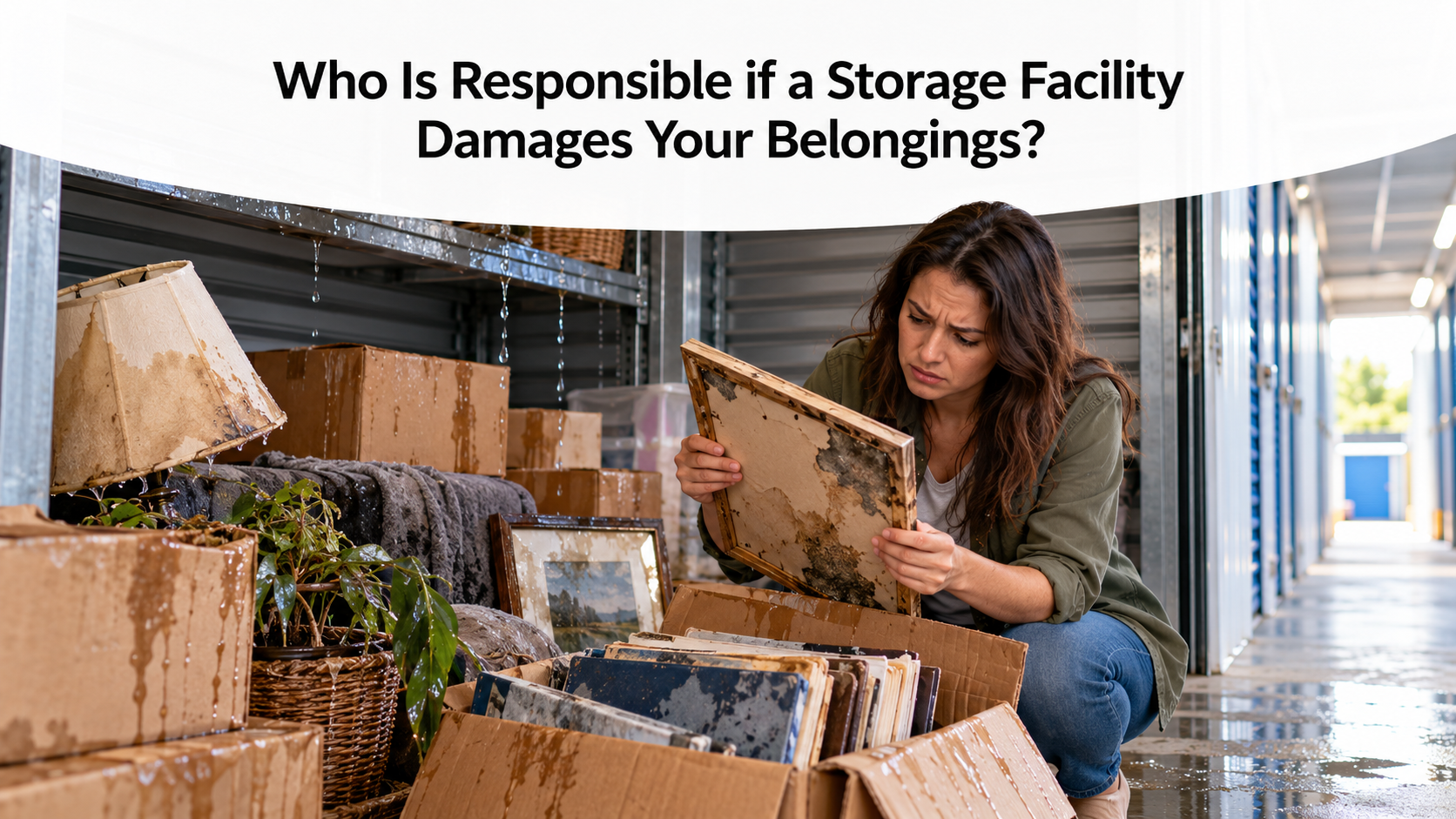
If a storage facility damages your belongings, responsibility depends on what caused the damage, whether the facility or its employees acted negligently, and what the rental agreement and applicable law require. A storage company is not automatically responsible for every loss that occurs on its property, but it may be liable when its actions, failure to maintain the premises, or other legally actionable conduct causes damage to a customer's belongings.
The distinction matters because storage facility liability and storage insurance are not the same thing. A facility may dispute responsibility under its rental agreement, while a separate insurance policy may provide protection against certain covered causes of loss. Understanding the cause of the damage, the facility's obligations, and the available insurance coverage is essential before deciding how to pursue reimbursement.
Key Takeaways
- A storage facility is not automatically responsible for every item damaged while inside a rented unit.
- The facility may be liable when its negligence, actions, or failure to meet a legal obligation causes property damage.
- Rental agreements often contain liability limitations, but their enforceability depends on applicable law and the circumstances.
- Damage caused by facility employees, maintenance failures, roof leaks, or preventable water intrusion may raise questions about the operator's responsibility.
- A storage facility's commercial property insurance does not automatically insure customers' belongings.
- Dedicated storage insurance may cover qualifying losses even when responsibility is disputed, depending on the policy terms.
- Photographs, maintenance records, incident reports, inventories, and written communications can help establish how the damage occurred.
Pro Tip
If you discover damage that may have resulted from the facility's actions or maintenance problems, photograph the affected belongings and the apparent cause before moving anything unnecessarily. Ask the facility for a written incident report and preserve communications about the problem. Our guide to handling a damaged storage unit explains why documenting the condition of the unit is an important step after discovering a loss.
Is a Storage Facility Responsible for Damage to Your Belongings?
A storage facility may be legally responsible for damaged belongings when the damage results from conduct for which the operator is liable. However, storing property at a facility does not mean the company guarantees that every item will remain undamaged under all circumstances.
Most self-storage arrangements involve renting space rather than transferring complete control of the belongings to the facility. Customers generally pack, place, secure, and manage their own property, while the operator provides access to and maintains the premises according to its contractual and legal obligations.
Responsibility therefore depends on more than where the damage occurred. The relevant questions include what caused the loss, whether the facility had a duty to address the risk, whether that duty was breached, and whether the breach caused the damage being claimed.
When Can a Storage Facility Be Held Liable?
A storage facility may face liability when its conduct satisfies the applicable legal requirements for negligence, breach of contract, or another recognized basis of responsibility. The exact standard varies by jurisdiction and the facts of the incident.
For example, a storage operator that knows about a serious roof defect but fails to take reasonable action may face different liability questions from an operator whose properly maintained building is damaged by an unexpected event. Knowledge of the hazard, reasonable maintenance practices, contractual obligations, and the connection between the operator's conduct and the resulting loss may all matter.
Storage Facility Responsibility at a Glance
| Cause of Damage |
Who May Be Responsible? |
| Negligent building maintenance |
The facility may be liable if a maintenance-related breach of duty caused the loss. |
| Employee accidentally damages belongings |
The operator or another responsible party may be liable depending on the employee's conduct and legal relationship. |
| Theft or burglary |
The thief is directly responsible; facility liability may depend on a separate breach of duty or contractual obligation. |
| Customer packs items improperly |
The customer may bear responsibility when their packing caused the damage. |
| Storm or natural disaster |
Responsibility depends on the cause, possible negligence, contract, law, and available insurance. |
| Defective storage equipment or doors |
The facility, equipment provider, or another party may be responsible depending on the defect and resulting loss. |
These examples illustrate possible responsibility rather than automatic legal outcomes. The governing contract, jurisdiction, evidence, and specific circumstances determine how a particular dispute should be evaluated.
What If the Storage Facility Damages Your Items During Maintenance?
Storage facilities sometimes perform repairs, pest treatments, roof maintenance, electrical work, door replacements, and other necessary building services. If belongings are damaged during this work, responsibility may depend on who performed the work and whether reasonable care was exercised.
For example, an employee may accidentally strike stored furniture while performing authorized maintenance, or a contractor may allow water or construction debris to enter an occupied unit. Such circumstances can raise questions about negligence, contractor liability, and the storage operator's legal obligations.
Document the condition of the property, identify the work being performed, and ask which company or contractor was involved. The fact that maintenance was taking place does not alone prove liability, but it can be relevant to establishing how the damage occurred.
Who Is Responsible if a Storage Facility Employee Damages Your Property?
When a facility employee damages customer property while performing job-related duties, the operator may face responsibility under applicable employment, negligence, or agency law. However, the result depends on the employee's conduct, scope of work, governing law, and other facts.
Consider an employee using facility equipment who accidentally damages stored furniture or another customer's belongings. Identifying who operated the equipment, what instructions were followed, and whether the conduct was reasonable may be important in determining responsibility.
Request written confirmation of the incident and preserve photographs, witness information, and any relevant messages from facility management. Avoid relying exclusively on verbal statements about who will pay for repairs or replacement.
Is the Storage Facility Responsible for Water Damage?
Water damage can arise from leaking roofs, damaged pipes, faulty drainage, defective doors, rain intrusion, flooding, or other sources. Determining facility responsibility requires identifying where the water came from and whether the operator failed to meet an applicable legal or contractual obligation.
If management knew about a recurring roof leak and failed to take reasonable corrective action, that information may be relevant to a negligence claim. By contrast, sudden external flooding may present different legal and insurance questions, particularly when the loss was not caused by a failure to maintain the facility.
Photograph wet belongings, ceiling damage, visible leaks, water marks, standing water, damaged doors, and other evidence showing the apparent source. The source of the water may also affect whether a separate insurance policy responds to the loss.
Can a Storage Facility Be Liable for Roof Leaks?
Potentially. A roof leak can raise questions about whether the facility performed reasonable inspections, responded to reported defects, and maintained the building according to applicable obligations. Evidence of repeated complaints, known water intrusion, or neglected repairs may be particularly relevant.
However, a leak does not automatically establish negligence. The circumstances surrounding the damage, the condition of the building, maintenance records, weather conditions, and the timing of the incident may all need to be reviewed before responsibility can be determined.
Is a Storage Facility Responsible for Mold Damage?
Mold and moisture damage can develop for several reasons, including prolonged leaks, humidity, condensation, poor ventilation, wet belongings, and inappropriate packing. Liability depends on the cause and whether the facility or another party failed to meet a relevant duty.
A facility-related moisture problem may raise different questions from mold that develops because damp clothing or furniture was packed into sealed containers. Even where the facility may be responsible for certain conditions, proving that those conditions caused the specific damage can be important.
Insurance coverage must also be considered separately because mold, mildew, gradual deterioration, and long-term moisture may be excluded or restricted under some policies.
What if the Storage Facility Has Faulty Doors or Security Equipment?
Defective doors, broken locks, malfunctioning access gates, and damaged security equipment can create risks for stored property. Whether the facility is responsible depends on the equipment involved, the operator's obligations, its knowledge of the condition, and how the defect contributed to the loss.
For example, a storage door that unexpectedly falls onto customer property may present a different liability issue from a customer improperly operating a functioning door. Maintenance histories, previous complaints, inspection records, and photographs can help establish the circumstances.
Is the Storage Facility Responsible if Someone Steals Your Belongings?
A storage facility is not necessarily legally responsible for every theft or burglary committed by a third party. Responsibility may depend on the operator's security obligations, representations, conduct, and whether a legally relevant failure contributed to the theft.
Security cameras, access gates, locks, fences, and lighting may reduce risks, but their presence does not guarantee that theft cannot occur. If a theft happens, preserve evidence of forced entry, damaged locks, missing property, facility communications, and any police report required or relevant to the incident.
You should also distinguish questions of facility liability from storage insurance coverage for theft or burglary. An insurance policy may have its own conditions, definitions, and exclusions regardless of whether a facility is legally responsible.
What Does the Storage Rental Agreement Say About Liability?
The storage rental agreement is one of the first documents to review after discovering damaged belongings. Many agreements address the allocation of risk between the storage operator and the customer, describe insurance requirements, and contain provisions limiting certain types of liability.
Common contractual provisions may address responsibility for stored contents, the operator's access rights, customer packing obligations, maximum declared property value, loss reporting, and insurance arrangements. However, the presence of a liability waiver does not automatically establish that every limitation is legally enforceable.
Applicable state or provincial law may affect whether particular provisions can be enforced. The wording of the agreement, the operator's conduct, and the type of claim may also matter. Review the entire contract rather than assuming a single disclaimer resolves every question of responsibility.
Can a Storage Facility Avoid Liability Through a Waiver?
A rental agreement may attempt to limit the operator's liability for certain losses, but such provisions do not necessarily eliminate every legal claim. Enforceability depends on the jurisdiction, the wording of the waiver, applicable consumer protection rules, and the circumstances of the alleged conduct.
Some jurisdictions distinguish between ordinary negligence and more serious misconduct when evaluating contractual limitations. Other legal requirements may also restrict attempts to disclaim specific duties. If the damage is substantial or the facility disputes responsibility, obtaining advice about the governing law may be appropriate.
Does the Storage Facility's Insurance Cover Your Belongings?
Not automatically. A storage operator may carry commercial property insurance protecting its buildings, equipment, or business assets. That coverage does not necessarily extend to belongings owned by individual customers renting storage space.
The operator may also carry commercial liability insurance, but whether that insurance responds to a customer property-damage claim depends on the applicable terms and the nature of the operator's legal responsibility. A business having insurance does not automatically mean every customer loss will be reimbursed.
Understanding what storage unit insurance covers can help distinguish protection for personal belongings from insurance maintained by the facility for its own operations.
What Is the Difference Between Facility Liability and Storage Insurance?
Facility liability concerns whether the operator or another party is legally responsible for causing the damage. Storage insurance concerns whether an eligible loss falls within the coverage provided by an insurance policy. These are related but separate questions.
For example, an insurance policy may provide coverage for a qualifying fire loss without requiring you to establish that the facility caused the fire through negligence. Conversely, the facility may potentially be liable for particular damage that your own storage insurance policy excludes.
| Facility Liability |
Storage Insurance |
| Depends on a legal basis for holding the operator responsible. |
Depends on the policy's covered causes of loss, conditions, and exclusions. |
| May involve negligence, contractual duties, or other legal obligations. |
May respond to an insured event without proving facility negligence. |
| May be subject to contractual limitations and applicable laws. |
Subject to policy limits, deductibles, exclusions, and claim requirements. |
| A disputed claim may require negotiation or legal proceedings. |
Claims are evaluated through the insurer's established process. |
Can You File an Insurance Claim if the Storage Facility Caused the Damage?
Potentially, yes. If you have storage insurance and your belongings are damaged by an insured cause of loss, you may be able to submit a claim even when the storage operator may have contributed to the incident. Coverage depends on the policy wording, circumstances, and applicable exclusions.
The insurer may investigate the cause, assess the damaged belongings, and determine whether payment is available under the policy. Depending on the circumstances and applicable law, an insurer that pays a covered claim may have rights to pursue reimbursement from a legally responsible third party.
Report any possible covered loss according to the claim instructions, even when responsibility is still being investigated. Customers can access the storage insurance claim filing page to begin the applicable reporting process.
What Should You Do if a Storage Facility Damages Your Belongings?
When you discover damaged property, take practical steps to preserve evidence, prevent additional loss where reasonably possible, and establish what happened. The order of these steps may depend on safety conditions and the severity of the damage.
1. Document the Damage Before Moving Belongings
Take photographs and video showing the condition of the storage unit, damaged belongings, visible defects, and surrounding area. Include wide images establishing the overall condition and close-up images showing specific damage. Do not enter an unsafe area merely to obtain evidence.
2. Notify Storage Facility Management
Report the incident to the facility promptly and request written acknowledgment. Explain when you discovered the damage, what you observed, and why you believe facility operations or conditions may have contributed. Avoid making unsupported accusations before the circumstances have been established.
3. Request an Incident Report
Ask the facility whether it has an incident reporting procedure and request any report it is willing or required to provide. Record the names of relevant staff members, dates of conversations, and any information about maintenance, repairs, or other activity affecting the unit.
4. Review Your Rental Agreement
Locate the signed rental agreement and review provisions concerning liability, insurance, property restrictions, incident reporting, and dispute resolution. The agreement may affect your contractual rights, but applicable law may also determine which provisions are enforceable.
5. Prepare an Inventory of Damaged Property
List the damaged belongings with their descriptions, approximate age, condition before the loss, and available ownership or value records. Photographs, receipts, order confirmations, warranties, and other evidence may help establish the items and support a reasonable assessment of the loss.
6. Notify Your Insurance Provider
If you have insurance that may apply, notify the provider within the applicable reporting requirements. Give an accurate account of the incident and explain any uncertainty about how the damage occurred. Do not assume that the facility's disputed responsibility makes an insurance claim unnecessary.
7. Keep Records of All Communications
Preserve emails, messages, incident reports, photographs, estimates, claim reference numbers, and written decisions. Understanding what happens after filing a storage insurance claim can help you prepare for documentation requests and the review process.
What Evidence Can Prove a Storage Facility Was Negligent?
Evidence of negligence may involve more than showing that belongings were damaged. It may be necessary to establish that the facility owed a relevant duty, failed to meet the applicable standard of care, and caused the resulting damage. The precise legal elements depend on the jurisdiction and circumstances.
Useful evidence may include photographs of defective building components, dated complaints about maintenance problems, written communications acknowledging an issue, incident reports, witness accounts, repair records, and information about previous occurrences. Security recordings may also be relevant if they exist and can lawfully be obtained.
A photograph showing water-damaged furniture establishes the condition of the furniture, but it may not establish why water entered the unit. Additional evidence connecting the damage to a particular defect or action can help clarify responsibility.
Can You Request Security Camera Footage From a Storage Facility?
You can ask the facility to preserve and review relevant security footage, but access to recordings may be restricted by company policies, privacy considerations, and applicable law. The operator may not be required to provide footage directly simply because a customer requests it.
If footage may show an employee, contractor, vehicle, or other activity connected to the incident, make a written preservation request promptly. Security systems may overwrite recordings after a limited retention period. In some disputes, relevant footage may be obtained through legal procedures when available and appropriate.
Can the Storage Facility Refuse to Pay for Damaged Belongings?
A facility may dispute a request for compensation if it believes the loss was not caused by its conduct, the claimed amount is unsupported, or the rental agreement limits its responsibility. However, a refusal to pay does not necessarily establish that the operator has no legal liability.
Ask for a written explanation of the decision and review the relevant contractual provisions. If the facility relies on a waiver or limitation, consider whether applicable law affects that provision. For substantial losses or unresolved disputes, advice from a qualified legal professional may help clarify available remedies and deadlines.
Can You Recover the Full Value of Damaged Belongings?
The amount recoverable depends on the legal basis of a claim, the evidence of loss, applicable contractual limitations, and relevant law. The amount originally paid for an item is not always the same as the legally recoverable measure of damages or the amount payable under an insurance policy.
For insurance claims, valuation may depend on actual cash value, replacement cost, special item limits, deductibles, or other policy conditions. For liability disputes, applicable law may determine what financial losses can be recovered. Keep repair estimates, ownership records, photographs, and other documents supporting the condition and value of the property before the incident.
Can You Sue a Storage Facility for Damaging Your Belongings?
Legal action may be available when a storage operator has allegedly breached a legal or contractual duty and caused compensable damage. However, whether a particular claim can proceed depends on the governing jurisdiction, applicable law, contract provisions, available evidence, and procedural requirements.
Some disputes may be suitable for small claims court, while others may be affected by arbitration clauses or other dispute resolution provisions. Filing deadlines, monetary limits, and procedural rules vary by location. Before pursuing legal action, assess the evidence, review the rental agreement, and consider obtaining appropriate legal guidance.
Can You File an Insurance Claim and Pursue the Storage Facility?
Depending on the circumstances, it may be possible to notify your insurer while separately addressing the facility's potential responsibility. However, insurance payments, settlement agreements, subrogation rights, and applicable law can affect how the claims interact.
You generally should not expect to recover the same compensable loss twice. If your insurer pays for eligible damage, it may acquire rights to pursue a responsible party under the policy and applicable law. Inform the insurer about any proposed settlement with the facility before signing a release that could affect those rights.
Does Storage Insurance Cover Damage Caused by Facility Negligence?
Storage insurance may respond when the resulting damage falls within an insured cause of loss, even if questions about facility negligence remain unresolved. However, the presence of negligence does not automatically make an otherwise excluded loss covered.
For example, a policy may cover certain sudden and accidental events while excluding gradual deterioration, mold, flooding, or other specified causes. The insurer evaluates the actual damage and cause of loss against the policy rather than treating every incident involving facility operations as automatically insured.
How to Reduce the Risk of Uninsured Storage Damage
Choosing a storage facility with appropriate maintenance and security practices can help reduce risks, but it cannot eliminate the possibility of damage. Customers should also review rental agreements, understand insurance requirements, and document valuable belongings before moving them into storage.
- Inspect the unit for water stains, visible leaks, damaged doors, and other maintenance concerns before move-in.
- Read the rental agreement's liability limitations and insurance requirements.
- Photograph the unit's condition before placing belongings inside.
- Keep an inventory of furniture, electronics, appliances, and other valuable property.
- Use appropriate packing materials and avoid placing moisture-sensitive belongings directly on the floor where practical.
- Report maintenance problems in writing and retain copies of your communications.
- Verify whether the storage insurance policy covers the risks relevant to the location.
- Review coverage limits when adding expensive belongings to storage.
Why Dedicated Storage Insurance Matters
When belongings are damaged, relying exclusively on the facility's potential legal responsibility can create uncertainty. The operator may dispute negligence, contractual limitations may apply, and establishing liability may require additional evidence or legal proceedings.
Dedicated self-storage insurance coverage provides a separate contractual framework for eligible property losses. The insurer reviews the reported event under the policy's covered causes, exclusions, deductibles, limits, and claim conditions, rather than relying solely on whether the storage facility acknowledges responsibility.
However, storage insurance does not replace proper facility maintenance or protect against every possible risk. Review the actual policy documents before purchasing coverage, especially when storing belongings susceptible to water, humidity, or other location-specific hazards.
How Is a Storage Insurance Claim Evaluated After Facility Damage?
The insurer generally needs to establish what happened, which belongings were affected, whether the cause of loss is insured, and what payment may be available under the applicable policy. Facility negligence may be relevant to understanding the circumstances, but coverage and legal liability remain distinct issues.
The claims team may request photographs, an inventory, receipts or other ownership records, an incident report, details of the damage, and communications with the facility. Understanding how storage insurance claims work can help you organize the required information and distinguish claim evaluation from a dispute over legal responsibility.
Questions to Ask After a Storage Facility Damages Your Property
- What caused the damage to my belongings?
- Was facility maintenance or employee activity involved?
- Did management know about the problem before the incident?
- Is there an incident report or relevant maintenance record?
- Can relevant camera footage be preserved?
- What does my rental agreement say about operator liability?
- Does applicable law limit the enforceability of liability waivers?
- Does my storage insurance cover this specific cause of damage?
- What evidence is needed to support a claim?
- Are there reporting, insurance, or legal deadlines I need to meet?
Conclusion: Storage Facility Responsibility Depends on the Cause of Damage
A storage facility may be responsible for damage to your belongings when its negligence, actions, or breach of an applicable obligation caused the loss. However, responsibility is not automatic simply because the belongings were inside a rented unit. The cause of the damage, rental agreement, evidence, and applicable law all matter.
If your belongings are damaged, document the scene, notify facility management, preserve relevant records, review the rental agreement, and report any potentially covered loss to your insurer. Storage facility liability and insurance coverage should be evaluated separately. A clear understanding of both can help you determine which options may be available for recovering the loss.
Frequently Asked Questions
Is a Storage Facility Legally Responsible for Damaged Belongings?
Not automatically. The facility may be legally responsible when its conduct meets the applicable requirements for negligence, breach of contract, or another legal claim. Responsibility depends on the cause of damage, contractual obligations, evidence, and governing law.
Does a Storage Facility Have to Pay for Water-Damaged Items?
Payment may be required when the facility is legally responsible for the damage. For example, negligent maintenance of a known roof leak may raise liability questions. However, the presence of water damage alone does not establish that the facility must reimburse the customer.
Who Pays if a Storage Facility Employee Breaks My Belongings?
The facility, employee, contractor, or another party may face responsibility depending on the circumstances and applicable law. If the damage occurred during an employee's assigned duties, legal principles concerning employer responsibility may be relevant.
Can a Storage Facility Refuse Responsibility Because of a Waiver?
A facility may rely on liability limitations in its rental agreement, but those provisions are not automatically enforceable in every situation. Their legal effect depends on the wording, jurisdiction, type of conduct, and applicable statutory restrictions.
Does Storage Insurance Cover Employee-Caused Damage?
Coverage depends on the cause of the damage and the terms of the insurance policy. Damage involving a storage employee is not automatically covered or excluded solely because an employee was involved. The insurer evaluates the reported loss under the applicable policy provisions.
What if the Storage Facility Denies Causing the Damage?
Ask for a written explanation, review the rental agreement, and preserve evidence concerning the cause and extent of the loss. Depending on the circumstances, you may also report the loss to your insurer or obtain legal advice about a potential claim against the facility.
Is a Storage Facility Responsible for Mold or Moisture Damage?
Responsibility depends on the source of the moisture and whether the facility breached an applicable duty. Mold caused by a neglected building leak may present different liability questions from mold resulting from damp belongings or improper packing. Insurance restrictions may also apply.
Can I Sue a Storage Facility for Negligence?
Legal action may be available if the facts support a recognized claim and the applicable procedural requirements are satisfied. The rental agreement, jurisdiction, evidence, filing deadlines, and possible dispute resolution provisions should be reviewed before proceeding.
Does the Storage Facility's Insurance Protect My Belongings?
Not necessarily. Commercial insurance held by the facility may cover the building, business assets, or qualifying liability claims without automatically providing direct property coverage for every customer's belongings. Dedicated storage insurance is a separate option that must be evaluated under its own terms.
Can I Claim From My Insurance if the Storage Facility Is at Fault?
Potentially, if the damage qualifies under your insurance policy. The insurer may assess the loss even when facility responsibility is disputed. If payment is made, subrogation provisions and applicable law may affect the insurer's rights against a responsible third party.
What Evidence Should I Keep if a Storage Facility Damages My Items?
Keep photographs and videos, an inventory of affected belongings, receipts or other ownership records, the rental agreement, incident reports, repair estimates, written communications, and any relevant maintenance or witness information. Evidence showing both the damage and its likely cause can be particularly useful.
How Long Do I Have to Report Damage Caused by a Storage Facility?
Reporting requirements may arise under the rental agreement, insurance policy, or applicable law. Insurance notification conditions and legal filing deadlines are not necessarily the same. Report damage promptly, preserve evidence, and review the requirements that apply to your situation.