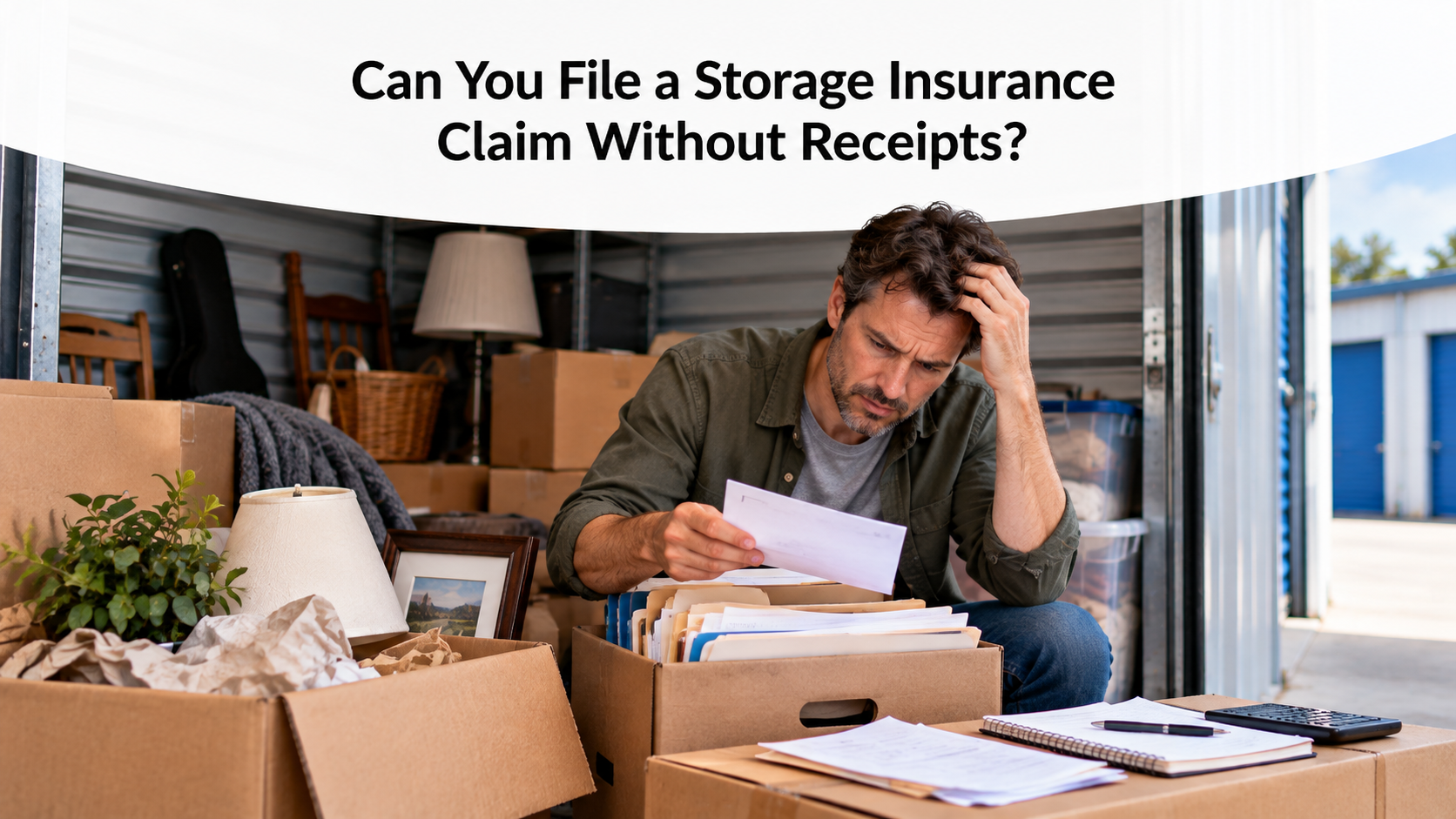
Yes, you may be able to file a storage insurance claim without receipts. A missing receipt does not automatically mean your claim will be denied. However, the insurance company still needs sufficient evidence to establish that the belongings existed, that you owned them or had an insurable interest in them, and that they were damaged, destroyed, or stolen in circumstances covered by your policy.
Receipts are one way to demonstrate ownership and purchase value, but they are not always the only acceptable evidence. Photographs, bank statements, online order confirmations, warranty records, serial numbers, appraisals, and detailed inventories may help support a claim when original purchase receipts are unavailable. Whether alternative documents are sufficient depends on the insurer's requirements and the circumstances of the loss.
Key Takeaways
- You can generally report a storage insurance loss even when you no longer have the original purchase receipts.
- Filing without receipts does not guarantee that the insurer will approve the claim or accept every claimed item.
- Photographs, bank statements, online purchase confirmations, warranties, and inventory records may help establish ownership.
- Proof that you owned an item and proof of its value are separate considerations during claim evaluation.
- Higher-value property may require more detailed documentation than ordinary household belongings.
- Missing documentation can lead to additional questions, delays, reduced accepted valuations, or denial of insufficiently supported items.
- Always provide accurate information and avoid inventing prices, purchase dates, or ownership records.
Pro Tip
If you cannot find a receipt, gather several independent records for the same belonging. A photograph, bank transaction, and product serial number may collectively provide stronger support than a general description alone. Understanding what proof of ownership is needed for a storage insurance claim can help you prepare more complete documentation before submitting your loss.
Can You Claim Storage Insurance Without Purchase Receipts?
You may still submit a claim without purchase receipts, but the insurer must determine whether the available evidence satisfies the applicable claim requirements. There is an important difference between reporting a loss and successfully proving that the loss qualifies for reimbursement.
Consider a storage unit containing furniture purchased several years ago. You may no longer have the original store receipts, but photographs showing the furniture inside your home before it was placed in storage, moving records, and other supporting information could help demonstrate that the belongings existed and were associated with you.
The insurer may still need to establish the approximate age, condition, type, and value of the items. Alternative evidence can support those questions, but acceptance is not guaranteed merely because some documentation is available.
Why Do Insurance Companies Ask for Receipts?
Insurance companies request receipts because they can help establish several important facts about a claimed item. A receipt may identify the product, purchase date, retailer, original price, and sometimes the buyer. These details can help the claims team evaluate ownership and determine how the property should be valued.
However, receipts do not prove every aspect of a storage insurance claim. A receipt showing that a television was purchased does not necessarily establish that the television was inside the insured storage unit when the incident occurred. Additional photographs, inventory records, or other evidence may be needed to connect the item to the reported loss.
What Can You Use Instead of Receipts for a Storage Insurance Claim?
Several types of documentation may help support ownership, identification, or value when purchase receipts have been lost. The usefulness of each document depends on what it establishes and whether it can reasonably be connected to the property included in the claim.
| Alternative Evidence |
How It May Support Your Claim |
| Photographs and videos |
Show that belongings existed, their appearance, and potentially their location before the loss. |
| Bank or credit card statements |
May establish a purchase transaction, although the specific item may need additional identification. |
| Online order confirmations |
Can identify the product, purchase date, seller, and original amount paid. |
| Warranty and registration records |
May connect a specific appliance or electronic device to the claimant. |
| Serial numbers and model details |
Help identify specific electronics, equipment, tools, and other individually marked items. |
| Storage inventories |
Help establish what belongings were recorded as being placed inside the unit. |
| Appraisals and valuation records |
May support the identity or estimated value of expensive or unusual property. |
| Moving and packing records |
Can help connect listed belongings to the storage unit or movement of property. |
No single alternative document is guaranteed to replace a receipt. The most useful approach is to combine accurate records that establish different aspects of the same item and ask the insurer which forms of evidence it will consider.
Can Photographs Prove Ownership Without Receipts?
Photographs can provide valuable supporting evidence, particularly when they were taken before the loss. Images showing furniture inside your home, appliances during a move, or packed belongings inside a storage unit may help confirm that particular items existed and were associated with your property.
However, a photograph alone may not conclusively establish ownership, purchase price, or whether the item was still inside the unit when the loss occurred. Its evidentiary value depends on the surrounding information and how clearly the photograph identifies the property.
Can Bank Statements Replace Missing Receipts?
Bank or credit card statements may help establish that you made a purchase from a particular retailer on a particular date. They can be especially helpful when combined with order history, product photographs, or other documentation identifying the purchased item.
For example, a bank statement showing a payment to an electronics retailer may confirm that a transaction occurred, but it may not identify whether you purchased a television, computer, or another product. Additional evidence may be necessary to establish the actual item involved in the claim.
Can You Use Online Shopping History as Proof of Purchase?
Online shopping accounts often retain information about previous orders, making them useful sources of replacement documentation. Digital purchase records may include the product name, order number, transaction date, price, and delivery address.
Search your email account for order confirmations and review the purchase history associated with retailers where you regularly shop. If the original invoice is unavailable, the retailer may be able to provide a duplicate or transaction record. These documents can help establish ownership and value, although additional evidence may still be needed to confirm that the item was stored in the insured unit.
What If You Bought the Items Several Years Ago?
Older belongings frequently have limited purchase documentation. Furniture, appliances, tools, and household goods may remain in use for many years after receipts have been discarded or digital purchase records have become inaccessible.
If you cannot establish the original purchase price, provide the most accurate information available about the item's description, estimated age, brand, model, condition, and comparable value. The insurer will evaluate whether this information is sufficient and apply the valuation provisions of the policy. Avoid presenting a current retail price as the original purchase price unless that is factually correct.
Can You Claim for Second-Hand Items Without Receipts?
Second-hand belongings can be particularly difficult to document because they may have been purchased through private transactions, resale platforms, garage sales, or cash payments. Some items may also have been received as gifts or inherited from family members.
Useful evidence may include dated messages with the seller, marketplace transaction history, payment records, photographs, shipping details, or documentation connected with the transfer of ownership. Whether the item is eligible and the supporting evidence is sufficient depends on the insurance policy and the insurer's review.
Proof of Ownership and Proof of Value Are Different
A storage insurance claim may involve two separate evidentiary questions: whether the claimant owned the property and how much the property was worth under the policy's valuation rules. Evidence supporting one question does not always answer the other.
A photograph showing a sofa in your living room may help demonstrate possession, but it does not necessarily prove the sofa's purchase price, age, or current replacement cost. Similarly, an online invoice can show that a sofa was purchased without proving that it remained inside the storage unit when the loss occurred.
| Evidence Question |
Examples of Supporting Information |
| Did the item exist? |
Photographs, videos, inventory records, and product documentation. |
| Did you own the item? |
Purchase records, registration details, transaction history, and other ownership documentation. |
| Was the item in storage? |
Storage photographs, packing lists, moving documents, and contemporaneous inventories. |
| How much was it worth? |
Purchase information, comparable items, appraisals, age, condition, and applicable policy valuation provisions. |
Can You File a Claim Without an Inventory or Receipts?
You may still report a loss even if you did not prepare a storage inventory before the incident. However, the insurer may need you to reconstruct a detailed list of affected belongings and provide supporting information for each claimed item.
Start with the items you can confidently identify. Review moving photographs, packing notes, previous household pictures, purchase histories, and communications related to the move. Organize belongings into categories such as furniture, electronics, appliances, clothing, tools, and household goods.
Be clear about which details you know and which are estimates. Reconstructing an inventory is not the same as creating new evidence, and an inventory prepared after the loss may require additional verification.
How to File a Storage Insurance Claim Without Receipts
If your storage belongings have been damaged or stolen and you cannot locate the original receipts, follow an organized process rather than delaying the initial loss report while trying to recover every purchase document.
1. Report the Loss Promptly
Notify the insurer according to the policy's reporting requirements. Explain what happened, when you discovered the loss, and which belongings appear to be affected. If purchase receipts are unavailable, explain that you are gathering alternative documentation. Customers can begin through the storage insurance claim filing page.
2. Photograph the Storage Unit and Affected Property
Once it is safe to access the unit, photograph the overall condition, individual damaged belongings, packaging, identification labels, and any visible signs explaining the loss. Preserve the original image files when possible. Do not discard damaged property before documenting it and checking the insurer's instructions unless safety requires immediate disposal.
3. Prepare a Detailed List of Missing or Damaged Items
Create a separate entry for each item or appropriately identified group of belongings. Include the product name, brand, model, approximate age, condition before the loss, and other details you can reasonably establish. Identify uncertain information as an estimate rather than presenting it as verified fact.
4. Collect Alternative Evidence
Search your email, bank accounts, online shopping history, warranties, cloud photographs, and storage records. Look for information that connects the claimed belongings to you and, where possible, to the insured storage unit. Organize supporting records by item so the insurer can understand what each document establishes.
5. Explain Missing Documentation
Tell the claims team why particular receipts are unavailable. The purchases may have been made years earlier, documentation may have been discarded, or the items may have been received as gifts. A truthful explanation helps the insurer understand why alternative records are being submitted.
6. Respond to Additional Requests
The insurer may request clarification about ownership, valuation, the circumstances of the loss, or specific items. Understanding what happens after filing a storage insurance claim can help you prepare for these questions and keep the claim organized throughout the review.
What Happens If You Cannot Prove the Value of Your Belongings?
When sufficient purchase information is unavailable, establishing the value of an item can become more complicated. The insurer may consider available descriptions, comparable products, photographs, documented condition, age, or other information permitted under the policy.
However, an insurer is not necessarily required to accept an unsupported estimate. A claimed value may need further verification, and the claim may be affected if the evidence is insufficient to establish the amount of the loss. The policy's valuation method, deductible, coverage limit, and any property-specific restrictions also apply.
Does Replacement Cost Coverage Eliminate the Need for Receipts?
No. Replacement cost coverage does not automatically eliminate the need to establish ownership, item identity, damage, or value. Even when a policy uses a replacement cost valuation method, the insurer may require documentation supporting the existence and characteristics of the claimed belongings.
Replacement cost and actual cash value are different valuation approaches. Replacement cost generally considers the cost of replacing eligible property with a comparable item under the policy terms, while actual cash value may account for depreciation. The specific insurance contract determines which method applies and whether additional requirements must be satisfied before payment.
Are Receipts More Important for Expensive Items?
Detailed documentation can be particularly important when a claim involves expensive electronics, premium furniture, specialist tools, artwork, collectibles, or other high-value belongings. The insurer may require more specific evidence to establish the item's identity, ownership, authenticity, or value.
Some categories of property may also be excluded or subject to special limits. Providing a receipt or appraisal does not override those policy restrictions. Before storing valuable property, check whether it is eligible and whether the available coverage is sufficient for the potential loss.
Can Your Storage Insurance Claim Be Denied Without Receipts?
A claim may be denied when the insurer determines that the evidence does not sufficiently establish a covered loss, ownership, item eligibility, or another required fact. However, missing receipts are not necessarily an automatic reason for denial in every case. The outcome depends on the policy wording, alternative evidence, and specific circumstances.
Other claim issues can also affect the decision. An excluded cause of loss, inactive coverage, restricted property, inaccurate information, or failure to satisfy a policy condition may result in a denial even when purchase documentation exists.
What Should You Do If a Claim Is Denied Because You Have No Receipts?
Start by reviewing the insurer's explanation and identifying which information was considered insufficient. The issue may relate to ownership, value, item identification, or another policy requirement. Ask whether additional documentation can be submitted and what evidence would help address the stated concern.
If you believe relevant information was overlooked, follow the reconsideration or appeal procedure available under your policy. Our guide explains how to appeal a denied storage insurance claim and why reviewing the insurer's stated reason is an important first step. Any deadlines or procedural requirements should be checked carefully.
Does Filing Without Receipts Take Longer?
It can. When original receipts are missing, the claims team may need to evaluate alternative evidence, request additional documents, confirm product details, or review estimates of the affected property's value. These steps can make the process more involved than a straightforward claim supported by complete records.
There is no universal processing period for claims submitted without receipts. A small loss involving clearly identified belongings may be easier to evaluate than a large claim involving numerous items and incomplete records. Read more about how long a storage insurance claim takes and the factors that may affect its progress.
What Should You Avoid When Filing Without Receipts?
Missing documentation can create uncertainty, but inaccurate information may create much more serious problems. Do not invent receipts, exaggerate replacement costs, change purchase dates, or include belongings that were not actually affected by the reported incident.
- Do not create or alter documents to make them appear to be original purchase receipts.
- Do not claim ownership of property that belongs to someone else without explaining the circumstances and your insurable interest.
- Do not present estimated values as confirmed purchase prices.
- Do not discard useful evidence before documenting it and reviewing claim instructions, unless safety requires otherwise.
- Do not ignore requests for clarification or supporting documentation.
- Do not assume that every item will be covered simply because it was stored in the insured unit.
How to Prepare for Future Claims When You Have No Receipts
The easiest time to document your belongings is before a loss occurs. Even if you have already discarded older purchase receipts, you can create a useful record of what you currently own and intend to place in storage.
- Photograph the contents of your storage unit before closing it.
- Create a written inventory with item descriptions, approximate ages, and identifying details.
- Record serial numbers and model information for electronics, appliances, and tools.
- Save digital invoices and online order confirmations when available.
- Keep relevant warranty records and appraisals for qualifying valuable belongings.
- Update your inventory when property is added to or removed from storage.
- Store backup records securely outside the storage unit.
- Review your insurance coverage limit and property restrictions periodically.
Do You Need Receipts Before Buying Storage Insurance?
Buying a storage insurance policy and documenting a future claim are separate processes. You should not assume that original purchase receipts must be submitted for every belonging when arranging storage coverage. However, the insurer may require particular information at enrollment, and the policy may impose documentation requirements if a loss occurs.
Before selecting self-storage insurance coverage, estimate the value of your belongings, check the eligible property categories, understand the applicable limits, and review what documentation could be requested during a claim. Preparing this information in advance can help you make a more informed insurance decision.
How Insurance Companies Evaluate Claims With Missing Documentation
The insurer must evaluate the reported loss using the applicable policy terms and available evidence. Missing receipts are one factor among several. The claims team may need to consider whether coverage was active, whether the incident qualifies as a covered cause of loss, whether the claimed property is eligible, and whether ownership and value have been sufficiently established.
This is why documentation should be organized around the facts of the claim rather than simply collecting as many unrelated records as possible. Our explanation of how storage insurance claims work provides further information about loss reporting, policy review, evidence, and claim resolution.
Conclusion: You May Be Able to File a Claim Without Receipts
You may be able to file a storage insurance claim without original purchase receipts, but you should be prepared to provide alternative evidence of ownership, item identity, value, and the reported loss. Photographs, online purchase records, bank statements, warranties, inventories, and other reliable documentation can help support your claim when receipts are no longer available.
The important distinction is that filing a claim does not guarantee its approval. The insurer must still determine whether the loss is covered and sufficiently documented under the policy. Report losses promptly, provide accurate information, keep copies of your supporting records, and follow any requests for additional documentation. Preparing an inventory before something goes wrong remains one of the most practical ways to make future claims easier to substantiate.
Frequently Asked Questions
Can I File a Storage Insurance Claim if I Lost All My Receipts?
You may still report the loss and submit a claim. However, the insurer may require other evidence establishing ownership, identification, and value. Photographs, online order records, bank statements, inventories, and other reliable documents may help support the claim, depending on policy requirements.
Will Storage Insurance Pay Without Proof of Purchase?
Payment may be possible when alternative evidence sufficiently establishes the claimed loss and all applicable policy conditions are satisfied. However, the absence of proof of purchase does not guarantee approval, and insufficient evidence may affect the insurer's ability to verify an item or its value.
Are Photos Enough for an Insurance Claim?
Photographs may provide useful evidence that belongings existed or were damaged, but they do not always establish ownership, purchase price, or location at the time of loss. The insurer may require additional supporting records depending on the circumstances.
Can Bank Statements Be Used Instead of Receipts?
Bank statements may help establish that a purchase transaction occurred. However, a transaction record may not identify the specific product purchased. Combining the statement with an order confirmation, photograph, or other identifying document can provide more complete evidence.
What If My Receipts Were Destroyed in the Storage Unit?
Explain the circumstances to the insurer and look for duplicate records outside the unit. Online purchase histories, emailed invoices, retailer transaction records, bank statements, and photographs may help replace some of the missing information.
Can I Claim for Furniture Bought Years Ago Without Receipts?
You may submit information about older furniture even when purchase receipts are unavailable. Photographs, product descriptions, approximate age, condition, and other supporting evidence may help establish the property involved. Eligibility and valuation remain subject to the policy.
Can I Claim for Gifts or Inherited Belongings Without Receipts?
Potentially, if the property qualifies under the policy and ownership or an insurable interest can be sufficiently established. Photographs, correspondence, inheritance records, appraisals, or other documents may help support the circumstances of ownership and value.
Does a Storage Insurance Claim Take Longer Without Receipts?
It can take longer if the insurer needs additional evidence to verify ownership, item identification, or value. The overall timeline depends on the circumstances of the loss, the quality of available documentation, and the policy's claim requirements.
Can My Storage Insurance Claim Be Denied Because I Have No Receipts?
A claim may be denied if the available information is insufficient to establish a required element of the loss. However, missing receipts do not necessarily cause automatic denial in every case. The insurer will evaluate the evidence and apply the relevant policy provisions.
What Is the Best Alternative to a Missing Receipt?
There is no single best alternative for every item. A combination of dated photographs, purchase confirmations, bank transactions, model details, serial numbers, and inventory records may provide useful support. Ask the insurer which evidence it requires for the specific property involved.
Do I Need Receipts for Every Item in My Storage Unit?
Not necessarily. Documentation requirements depend on the insurance policy and the circumstances of a claim. Nevertheless, maintaining purchase records and other evidence for major belongings can make it easier to establish their identity, ownership, and value if a loss occurs.