When you file a storage unit insurance claim, submitting the initial claim form is only the beginning. The insurer must review the circumstances of the loss, identify the property involved, determine whether the reported event falls within the applicable policy, and evaluate the information supporting the claim. Depending on the situation, you may be asked for photographs, receipts, inventory records, ownership information, details about the storage facility, or other documentation.
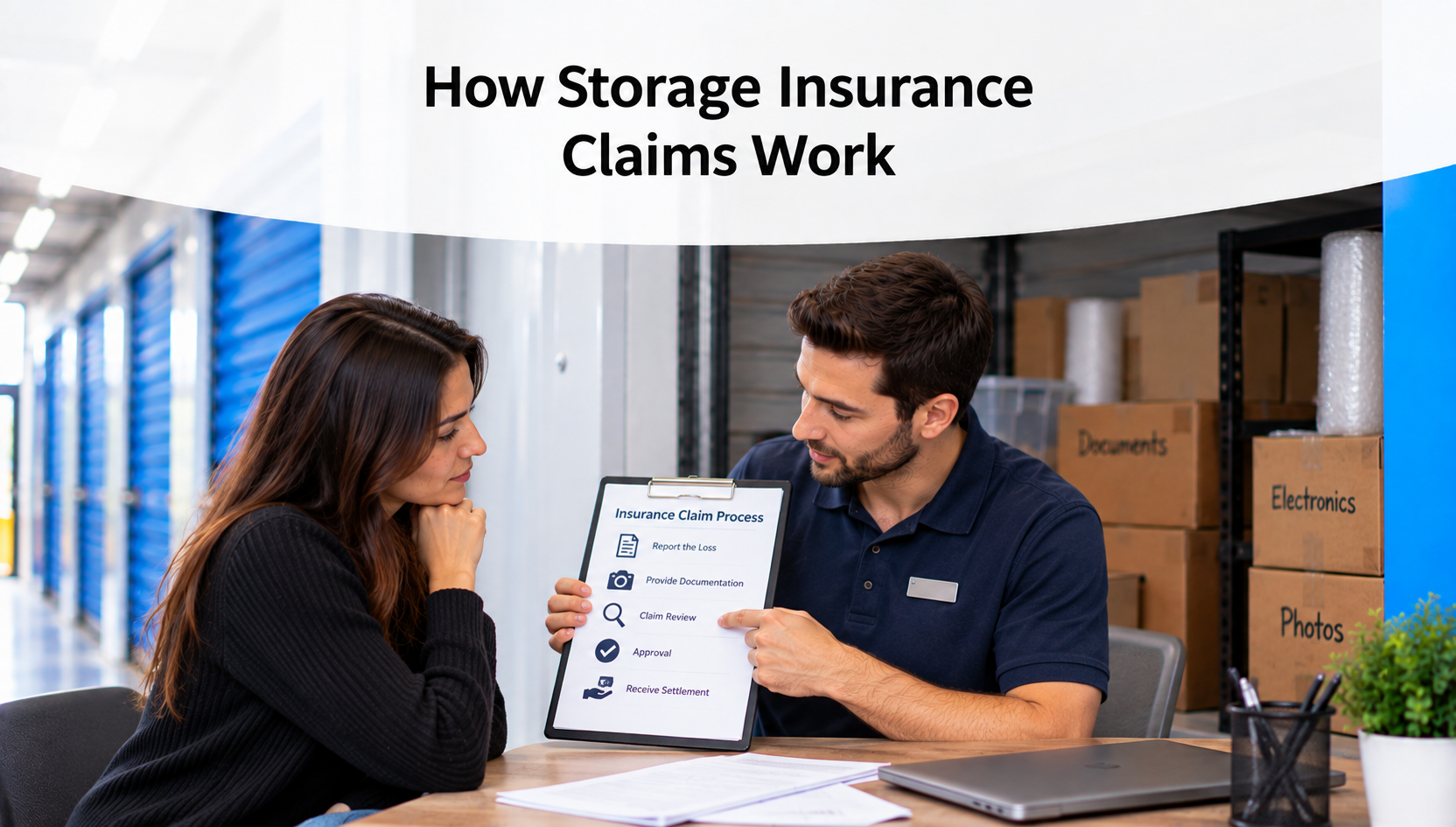
The process can feel uncertain if you do not know what happens next. In general, the claim moves through reporting, documentation, review, coverage determination, and resolution. Some claims are relatively straightforward, while others require additional information before the insurer can make a decision. Understanding each stage can help you respond accurately, preserve useful evidence, and avoid preventable complications.
Key Takeaways
- After a claim is filed, the insurer reviews what happened, which belongings were affected, and how the loss fits the policy terms.
- Photographs, receipts, inventory records, serial numbers, and other ownership documents can help establish the property involved in the claim.
- The insurer may request additional information before deciding whether the loss is covered and what amount may be payable under the policy.
- A claim can take longer when the cause of loss is unclear, documentation is incomplete, numerous items are involved, or coverage questions need further review.
- A denial does not mean every part of a loss was necessarily outside the policy; the explanation should be reviewed against the applicable policy provision.
- Keeping detailed records before a loss occurs can make the claims process easier to document and manage.
Pro Tip
Create your storage inventory before a claim is ever needed and keep a copy somewhere outside the unit. Photograph expensive belongings, record serial numbers and model information, and save receipts or purchase confirmations where available. If the storage unit becomes inaccessible after a loss, you will still have independent records showing what was stored and helping you organize the information requested during the claim review.
What Should You Do Immediately After a Storage Loss?
Your first priority should be safety. If the storage unit has structural damage, damaged electrical components, unstable objects, standing water, broken doors, or another obvious hazard, do not enter simply to retrieve belongings. Contact the storage facility and follow its instructions before approaching or opening a damaged unit.
Once the area is safe to inspect, document the condition before making unnecessary changes. Take photographs of the exterior of the unit, the door and lock, the interior, visible damage, and individual belongings that appear damaged. A combination of wide photographs and close-up photographs can provide a clearer record than either type alone.
Make a preliminary list of everything you believe was damaged, destroyed, or missing. Include enough detail to distinguish similar items, such as the brand or model of an electronic device, the type of appliance, or a description of a piece of furniture. Keep the list factual and avoid estimating details you cannot reasonably establish.
Why Should You Document the Unit Before Moving Anything?
Once belongings are moved, cleaned, repaired, or discarded, it can become harder to demonstrate the original condition. Photographs provide a contemporaneous record of what you saw when the loss was discovered. This is particularly useful when the damage is extensive or when the cause of the loss needs to be evaluated.
Immediate action can still be necessary when it prevents additional damage or addresses a safety concern. In those circumstances, document what you can before taking protective measures and keep receipts for reasonable emergency expenses when appropriate.
How Do You Report a Storage Unit Insurance Claim?
Report the loss using the claims instructions provided with your insurance policy. Include the basic facts of the incident, such as when the loss was discovered, where the belongings were stored, what appears to have happened, and which property was affected. If you do not know the exact cause or timing, state what you know rather than filling in uncertain details.
The storage facility should also be contacted when appropriate. The facility may have its own incident-reporting requirements and may possess information that could be relevant to the circumstances, such as records of the event or information about the condition of the unit.
Keep a copy of everything you submit and note the claim reference number if one is provided. Save emails, photographs, forms, receipts, and other correspondence together so you can quickly identify what has already been provided if additional questions arise.
What Documents Are Needed for a Storage Insurance Claim?
The exact documents depend on the claim and the applicable policy, but most well-supported claims involve evidence about the loss and the belongings affected. Useful documentation can include photographs, receipts, purchase confirmations, inventory records, serial numbers, model information, appraisals, and other ownership or valuation records.
For damaged property, photographs showing the condition of the item can be particularly useful. For missing belongings, an inventory, purchase records, photographs, serial numbers, or other evidence can help identify what was stored. For expensive or unusual property, documentation that establishes value may receive greater attention during the review.
The important point is consistency. If an item appears in your inventory, photograph, receipt, and claim under substantially different descriptions, additional clarification may be necessary. Keep the information as accurate and specific as the available records allow.
What Counts as Useful Ownership Evidence?
Ownership evidence can take several forms. A receipt is useful, but it is not the only possible record. A purchase confirmation, photograph of the item, serial number, warranty record, appraisal, account statement showing a purchase, or detailed inventory can provide additional support. The most appropriate evidence depends on the type and value of the item.
How Does the Insurance Company Investigate a Storage Claim?
The review is generally focused on establishing the facts. The insurer needs to understand what happened, when the loss occurred or was discovered, what property was affected, and whether the reported circumstances fall within the policy. Information you provide may be compared with photographs, documents, facility information, and other evidence connected with the loss.
The insurer may ask follow-up questions when something is unclear or additional information is needed. For example, a claim involving damaged electronics may require details about the devices, their condition, their location in the unit, and how the damage occurred. A claim involving missing property may require more information about the affected items and evidence that they were actually stored in the unit.
You should answer questions carefully and truthfully. If a detail is uncertain, identify it as uncertain rather than making an unsupported assumption. The purpose of the investigation is to establish the circumstances of the claim so the applicable policy terms can be applied to the facts.
What Happens During a Storage Insurance Claim Review?
Once the insurer has the information needed to evaluate the claim, the reported loss is considered against the policy. This includes determining whether the type of property is eligible, whether the cause of loss is covered, whether an exclusion applies, and how the applicable coverage limit and deductible affect the claim.
The value of the property can also be important. The amount you paid for an item, its current replacement cost, its age, and the policy's valuation rules may all be relevant depending on the coverage. The amount available under the policy is also subject to its stated limits and conditions.
Certain categories of property may receive different treatment. Electronics, jewelry, collectibles, artwork, antiques, and other higher-value belongings can have special restrictions or limits under some policies. Review the applicable coverage limits rather than assuming the overall policy limit applies equally to every item.
Why Can the Same Loss Affect Different Items Differently?
Different belongings can have different values, eligibility requirements, or policy limits. For example, ordinary household goods may be treated differently from a high-value collectible or piece of jewelry. The cause of the loss can also matter if a policy covers some causes of damage while excluding others.
How Long Does a Storage Unit Insurance Claim Take?
There is no single timeline that applies to every storage unit insurance claim. The time required depends on the nature of the loss, the number and type of belongings involved, the quality of the supporting documentation, and whether additional review is needed to determine coverage or value.
A claim involving a small number of clearly identified items and a well-documented covered event may be relatively straightforward. A larger loss can involve many items, multiple categories of property, questions about the cause of damage, or additional documentation. Those factors can make the review more involved.
Rather than relying on a fixed number of days, focus on whether the claim file is complete and whether the insurer has everything needed for its evaluation. If information is requested, responding accurately and promptly can help avoid unnecessary pauses in the review.
What Can Delay a Storage Insurance Claim?
Missing or incomplete documentation is one common reason a claim may require additional work. If an item is listed without supporting information about ownership, value, or identity, the insurer may need to request more evidence. A vague description of the incident can also lead to additional questions.
Complexity is another factor. A claim involving extensive damage, many different categories of belongings, an uncertain cause of loss, or property with specific policy restrictions may require a more detailed review than a straightforward claim involving ordinary household contents.
Avoidable mistakes can also create problems. Failing to report the loss promptly, misunderstanding exclusions, storing restricted property, failing to preserve evidence, or providing inconsistent information can complicate the claim. Reviewing common claim mistakes before a loss occurs can help you avoid some of these issues.
What Happens If Your Storage Insurance Claim Is Denied?
A claim may be denied when the reported loss does not satisfy the policy's coverage requirements. The reason could involve an excluded cause of loss, ineligible property, a policy condition, insufficient evidence, or an applicable coverage limit. The specific explanation matters because it identifies why the insurer determined that payment was not available under the policy.
If your claim is denied, read the written explanation carefully and identify the policy provision cited. Compare that explanation with the circumstances you reported and the documentation you provided. If you believe relevant information was overlooked or additional documentation is available, follow the insurer's stated process for requesting reconsideration or appealing the decision.
A denial is not a reason to discard your records. Keep the claim file, correspondence, photographs, receipts, and policy documents together. These records provide the clearest history of what was submitted and how the claim was evaluated.
How Can You Prepare for a Storage Insurance Claim?
The best claim preparation takes place before a loss. Start with a complete inventory of the property you intend to store. Do not focus only on expensive items; smaller household belongings can add significant value when combined. Furniture, appliances, clothing, kitchenware, electronics, tools, seasonal items, books, and other contents should all be considered.
Estimate what it would cost to replace comparable belongings today, while remembering that the final claim valuation depends on the policy's specific terms. Keep documentation for higher-value items and record identifying information where possible.
A practical item inventory can help you calculate a realistic total value and compare that figure with the coverage limit you intend to purchase.
How Should You Document Expensive Belongings?
For electronics, photograph the item and record its model and serial number. For furniture and appliances, keep purchase records and clear photographs. For collectibles, artwork, jewelry, or other specialty property, retain documentation that helps establish authenticity, ownership, and value where appropriate.
Store these records outside the unit. A secure digital copy can remain accessible even if the physical contents are temporarily inaccessible after an incident.
What Should You Keep During the Claim Process?
- Your insurance policy and coverage documents.
- The claim reference number and submission confirmation.
- Photographs and videos of the storage unit and affected belongings.
- Your inventory and list of damaged or missing property.
- Receipts, purchase records, appraisals, serial numbers, and other supporting evidence.
- Copies of every email, form, letter, or other communication related to the claim.
Should You Contact the Storage Facility During a Claim?
Yes, when the circumstances require it. The storage facility and the insurer have different roles, so a claim involving theft, damage to the unit, water intrusion, fire, or another incident may require communication with both. The facility may need to document the incident or explain its own reporting procedures, while the insurer evaluates the loss under the insurance policy.
Keep facility communications with your insurance records. If the facility provides an incident report or other written documentation, retain a copy rather than relying only on a verbal explanation.
How Do Policy Exclusions Affect the Claim Review?
An insurance claim is evaluated against the actual policy wording, not simply against the general idea that stored belongings are insured. Policies can exclude particular causes of loss, types of property, or circumstances. Water-related losses, mold, pests, gradual deterioration, improper storage, certain valuable belongings, and other situations may receive different treatment depending on the policy.
This is one reason it is useful to review policy terms before storing your belongings. Understanding exclusions in advance can help you recognize which information will matter if a loss occurs and can prevent incorrect assumptions about the scope of coverage.
How Does Ownership Evidence Affect the Claim?
An insurer needs to determine what property was actually affected by the reported loss. Ownership and inventory records can help connect individual belongings to the person making the claim. This can be particularly important when a claim includes many similar items or higher-value property that is difficult to identify from photographs alone.
The strongest records are usually those created before the incident. A photograph taken before storage, combined with a receipt and serial number where applicable, provides more useful evidence than trying to reconstruct the item's identity after it has been lost or damaged.
How Can You Keep a Storage Insurance Claim From Becoming More Complicated?
Start with accurate information and keep the claim organized from the first report through the final decision. Use consistent item descriptions, provide documents in a logical format, answer questions directly, and keep copies of everything you send. Avoid changing or exaggerating values because you believe doing so will increase a potential payment.
It is equally important not to overlook small belongings. A claim should reflect the property actually affected by the loss. Your pre-loss inventory can help ensure that ordinary household items are not forgotten simply because they were inexpensive individually.
Conclusion: What Happens After Filing a Storage Insurance Claim?
After you file a storage unit insurance claim, the insurer reviews the circumstances of the loss, identifies the property involved, examines the supporting documentation, and applies the applicable policy terms. You may be asked for additional information before the insurer can complete its evaluation. The process can involve reviewing photographs, receipts, inventory records, ownership evidence, the cause of the loss, coverage limits, exclusions, and other relevant conditions.
There is no single timeline or outcome that applies to every claim. A well-documented, straightforward loss may be easier to review than a complicated claim involving extensive damage, multiple categories of property, uncertain circumstances, or incomplete records. The best preparation is to create your inventory before a loss, preserve ownership and value records, document damage carefully, report the incident promptly, and respond accurately to any requests from the insurer.
The goal of the claims process is to establish the facts and determine how the reported loss fits within the policy. Keeping accurate records and understanding your coverage before an incident occurs can make that process substantially easier to navigate.
For storage renters reviewing dedicated protection for eligible belongings, Discount Storage Insurance provides storage insurance options and resources for understanding coverage before a loss occurs.
Frequently Asked Questions
How Long Does a Storage Insurance Claim Take?
There is no fixed timeline for every storage insurance claim. The time required depends on the circumstances of the loss, the property involved, the completeness of the documentation, and whether additional information or investigation is needed before a decision can be made.
What Documents Do You Need for a Storage Insurance Claim?
Depending on the loss, useful documents can include photographs, receipts, purchase confirmations, inventory records, serial numbers, appraisals, storage information, and other records that establish ownership, identity, condition, or value. The insurer may request additional documentation based on the circumstances.
What Happens During a Storage Insurance Claim Investigation?
The insurer reviews the circumstances of the loss, the affected property, the supporting evidence, and the policy terms. Follow-up questions may be asked when the cause of loss, ownership, item value, or other details need clarification.
What Can Cause a Storage Insurance Claim to Be Delayed?
Incomplete documentation, unclear descriptions, missing ownership records, extensive damage, uncertain causes of loss, and unresolved coverage questions can all make a claim more involved. Providing accurate information and responding to requests promptly can help reduce avoidable delays.
What Happens If a Storage Insurance Claim Is Denied?
The insurer should provide the reason for the denial based on the applicable policy terms. Review the explanation carefully, identify the provision involved, check the information submitted with the claim, and follow any available process for requesting reconsideration or appealing the decision.