Many storage facilities require proof of insurance before allowing customers to move belongings into a unit. Without acceptable documentation, your move-in may be delayed, or the facility may add its own protection plan to your rental account. Preparing your insurance documents in advance can help you complete check-in, access the unit, and begin storing your property without unnecessary complications.
Proof of insurance for a storage unit is usually a document confirming that your stored belongings are covered under an active policy. Depending on the storage facility and insurance provider, acceptable proof may include a confirmation of coverage, declaration page, insurance certificate, or another document showing the insured person, storage location, coverage amount, and effective date.
The best time to arrange this documentation is before move-in day. Confirming the facility’s requirements, selecting appropriate coverage, entering the correct storage details, and submitting the document early can reduce the risk of delays or rejected paperwork.
Pro Tip
Ask the storage facility what information must appear on your proof of insurance before purchasing a policy. Some facilities only need evidence of active coverage, while others may require the facility address, unit number, minimum coverage limit, policy number, and coverage start date to appear on the document.
Key Takeaways
- Many storage facilities request proof of insurance before move-in.
- Acceptable documents may include a confirmation of coverage, declaration page, or insurance certificate.
- The document should contain accurate policyholder, facility, coverage, and effective-date information.
- A payment receipt alone may not provide enough information to prove active coverage.
- Submit the document before move-in and confirm that the facility has accepted it.
- Portable storage containers may require a different type of insurance documentation.
What Is Proof of Insurance for a Storage Unit?
Proof of insurance is written confirmation that an insurance policy is active for the belongings being placed in storage. It helps the facility verify that the renter has arranged financial protection for personal property rather than relying on the storage company to reimburse losses.
The exact name of the document varies by provider. It may be called proof of coverage, confirmation of coverage, an insurance certificate, a policy schedule, or a declaration page. The document name is less important than the information it contains and whether the storage facility accepts it.
Proof of insurance is not the same as the complete insurance policy. The full policy explains covered events, exclusions, limits, deductibles, claim conditions, and other terms. The proof document is normally a shorter summary used to verify that qualifying coverage exists.
Why Storage Facilities Request Proof Before Move-In
A storage rental agreement generally covers access to the rented space, while insurance covers eligible belongings against specific risks and subject to policy terms. These are separate arrangements. Paying rent for a unit does not necessarily mean the storage company insures everything placed inside it.
Facilities may therefore require customers to maintain insurance or another qualifying protection option throughout the rental period. Proof of insurance gives the facility evidence that the requirement has been addressed before the customer begins using the unit.
Insurance requirements differ between storage companies and locations. One facility may accept a homeowners or renters insurance declaration page, while another may ask for a dedicated storage policy. Always follow the written requirements in your rental agreement and confirm any unclear instructions with the facility manager.
What Should Storage Unit Proof of Insurance Include?
Before submitting a document, check that it contains enough information for the facility to match the insurance to your rental account. Missing or incorrect details are common reasons for proof of coverage to be questioned or rejected.
| Information |
Why It Is Important |
| Policyholder’s full name |
Helps match the policy to the storage rental account |
| Insurance provider |
Identifies the company providing the coverage |
| Policy or confirmation number |
Provides a reference for the active coverage |
| Storage facility address |
Shows the location connected with the stored property |
| Storage unit number |
Identifies the specific rented unit when required |
| Coverage limit |
Shows the selected amount of protection |
| Effective date |
Confirms when the policy becomes active |
| Policy expiration or renewal information |
Helps confirm whether coverage remains active during the rental |
Not every facility requires every item listed above. For example, you may not receive your unit number until the rental is completed. Ask whether the facility accepts proof showing the facility address first and allows the unit number to be added afterward.
How to Get Proof of Insurance for a Storage Unit Before Move-In
Getting acceptable proof of insurance is easier when you complete the steps in the correct order. Start with the facility’s requirements rather than buying a policy first and discovering later that the document does not contain the information the facility expects.
1. Ask the Facility What It Accepts
Contact the storage facility or review your rental agreement before move-in. Ask whether insurance is mandatory, what minimum coverage amount is required, and which documents can be used as evidence.
You should also confirm whether the storage company needs to be listed on the document, whether the unit number must appear, and how the proof should be submitted. Request written instructions when possible so you can compare them with the insurance document before sending it.
2. Check Your Existing Homeowners or Renters Policy
If you are thinking, “I have homeowners insurance,” your policy may include some off-premises personal property coverage, but the amount, duration, deductible, exclusions, and storage-related conditions depend on the policy. Contact your insurer rather than assuming your belongings are fully protected.
Ask whether the policy covers property stored at the specific facility, how much coverage applies, and whether the insurer can provide documentation that satisfies the facility’s requirements. Review any limits for electronics, business property, jewelry, artwork, collectibles, documents, and other valuable items.
Even when your existing policy provides some protection, compare the deductible and available coverage with the replacement value of your stored belongings. Limited off-premises coverage may not be sufficient for a unit containing furniture, appliances, electronics, or business inventory.
3. Consider Independent Storage Insurance
When your existing insurance does not meet the facility’s requirements or provides insufficient protection, you may be able to purchase coverage independently. A dedicated storage policy is designed specifically for belongings kept in a storage arrangement and can provide separate documentation for the rented unit.
Customers preparing for move-in can review coverage options through Discount Storage Insurance. Before purchasing, compare the coverage limit, deductible, covered causes of loss, exclusions, eligible property, start date, cancellation terms, and documentation provided after enrollment. This can also help you understand how does insurance coverage compare between storage providers?
4. Gather the Information Needed to Purchase Coverage
Prepare the information needed to connect the policy with the correct storage arrangement. If you are asking, what information do I need to get a quote for contents insurance for storage unit? you will generally need the storage provider name, facility address, move-in date, unit information when available, estimated value of your belongings, and the required coverage amount. Providing accurate details helps prevent errors on your proof of insurance.
- Your full legal name and contact information
- The storage company or provider name
- The complete facility street address
- The storage unit number, when available
- Your scheduled move-in date
- The estimated replacement value of your belongings
- The coverage amount required by the facility
- Your preferred coverage start date and billing information
Use the facility’s complete physical address rather than only the company name. Large storage brands may operate several facilities in the same city, so an incomplete address could connect the policy with the wrong location.
5. Choose an Appropriate Coverage Amount
Do not select a coverage amount only because it satisfies the facility’s minimum requirement. Estimate what it would cost to replace the belongings you plan to store after a covered loss. Include furniture, clothing, appliances, electronics, tools, household goods, seasonal items, and other eligible property.
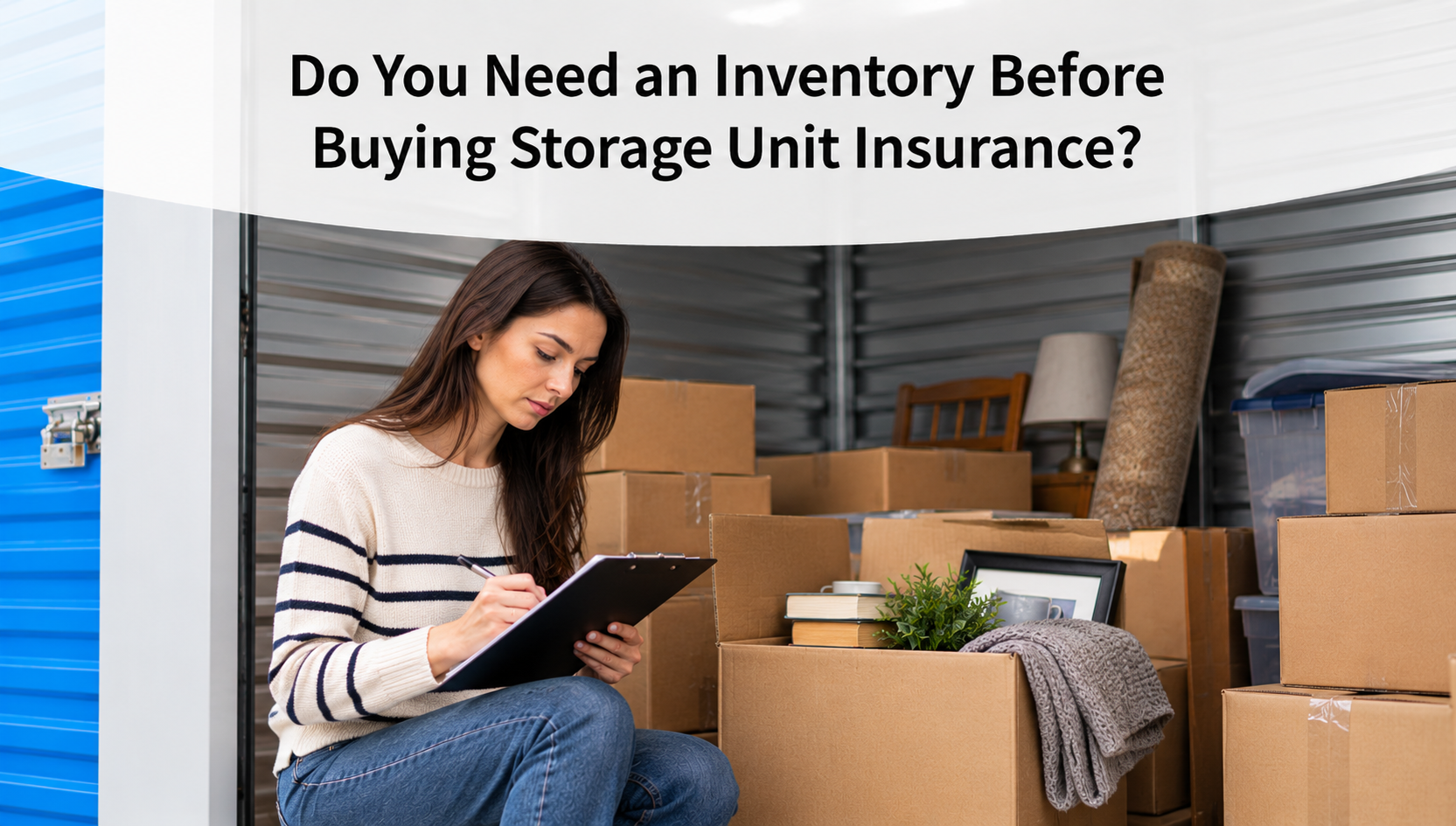
Create a basic inventory before purchasing the policy. Photograph major items, record model and serial numbers, and retain receipts where available. The total replacement estimate can help you compare coverage options and may also support a future claim.
Review restrictions applying to valuable or unusual property. A policy’s overall coverage limit does not necessarily mean every item is covered for its full value. Certain categories may have separate limits or may be excluded.
6. Select the Correct Effective Date
Choose a coverage start date that is no later than the day your belongings enter the storage unit. A policy beginning after move-in may leave your property uninsured during the first part of the rental period and may not satisfy the facility’s check-in requirements.
If you plan to drop off belongings before the official move-in appointment, use the actual date the property will enter storage when discussing the effective date with the provider. Also confirm whether your moving journey is covered, because protection inside the unit does not automatically mean property is insured while being transported.
7. Obtain Your Proof of Insurance
After purchasing or activating coverage, look for the confirmation document in your email or online account. Download the complete document rather than relying on a payment receipt, bank statement, or screenshot showing only that a transaction occurred.
Review the policyholder name, facility address, unit number, coverage limit, and effective date. Contact the insurance provider promptly if anything is missing or incorrect. Do not edit the document yourself, as altered insurance paperwork may not be accepted.
8. Submit the Document to the Storage Facility
Follow the facility’s preferred submission method. You may be asked to upload the document through a rental portal, email it to the facility manager, bring a printed copy, or submit it during online check-in.
Use a clear PDF or high-quality digital copy. A cropped image, unreadable screenshot, missing page, or password-protected document may delay verification. Include your rental reference or unit number in the email subject line when requested.
9. Confirm That the Proof Has Been Accepted
Sending the document does not always mean the facility has reviewed and approved it. Contact the facility before move-in to confirm that the proof is attached to your account and that no additional information is required.
Ask whether any facility protection fee has been removed from your rental account after your independent coverage was accepted. Keep the facility’s acceptance email or confirmation message with your rental and insurance records.
Which Insurance Documents May Be Accepted?
Storage companies may accept different forms of evidence depending on their policies. Confirm the requirements directly rather than assuming every insurance document will be sufficient.
| Document |
What to Check |
| Confirmation of coverage |
Should show active coverage and relevant storage details |
| Policy declaration page |
Should identify the insured person, limits, and policy dates |
| Certificate of insurance |
Should contain the information requested by the facility |
| Insurer verification letter |
Should be issued directly by the insurance provider |
| Insurance identification card |
May not contain enough property or storage information |
| Payment receipt |
May prove payment but not the scope or status of coverage |
Can You Get Proof Before Receiving Your Unit Number?
You may need to arrange insurance before the storage company assigns your unit number. Whether coverage can be completed without it depends on the provider and facility. Some application processes allow customers to begin using the facility information and update the unit number later.
Ask the facility whether the unit number is required on the initial proof of insurance. If it is not yet available, provide the complete facility address and expected move-in date, then update the policy as soon as the unit is assigned.
Do not leave the policy permanently connected to incomplete or temporary details. Retain written confirmation after the unit number has been added and submit the revised document to the facility if requested.
Independent Insurance, Facility Protection, or Existing Coverage?
There may be several ways to satisfy a storage facility’s insurance requirement. The right option depends on the facility’s rules, your existing coverage, the value of your belongings, and the policy terms.
| Coverage Option |
Important Questions |
| Homeowners or renters insurance |
How much off-premises coverage applies, and will the facility accept the documents? |
| Facility protection option |
Is it insurance or a protection plan, and what limits, deductibles, and exclusions apply? |
| Independent storage coverage |
Does it cover the intended property and provide acceptable proof before move-in? |
Customers looking specifically for protection connected with a conventional self-storage space can review the available Storage Unit Insurance information. Read the complete policy documentation rather than selecting coverage based only on the monthly price or facility requirement.
Common Reasons Proof of Insurance Is Rejected
Even an active policy may not be accepted immediately if the submitted document is incomplete, outdated, or inconsistent with the rental account.
- The policyholder name does not match the name on the rental agreement.
- The document shows the wrong storage facility or an incomplete address.
- The coverage effective date begins after the scheduled move-in date.
- The policy has expired or does not show current renewal information.
- The selected coverage amount is below the facility’s minimum requirement.
- Only a receipt or transaction screenshot was submitted.
- The uploaded file is blurry, cropped, incomplete, or password-protected.
- The document does not identify personal property or off-premises coverage.
- The unit number is missing when the facility specifically requires it.
If your proof is rejected because the required information is not there, ask the facility to identify the exact missing information. Send that request to the insurance provider rather than repeatedly uploading the same document.
How to Get Proof for a Same-Day Storage Move-In
A same-day move-in leaves less time to correct errors, so gather the facility details before beginning the insurance application. Confirm the minimum coverage amount, required document type, exact address, unit number, and submission email or portal.
After purchasing coverage, check your email inbox, spam folder, and online account for the confirmation document. Review it immediately and send it to the facility using the requested method. Call the facility before arriving to verify that the document has been received and accepted.
Keep a copy available on your phone and download it for offline access. This can be helpful when the storage facility has limited internet access or the original email cannot be located during check-in.
What to Do If Your Proof Is Delayed
Contact the insurance provider if the document does not arrive or cannot be downloaded. Confirm that the email address was entered correctly and ask whether the proof can be resent or accessed through your account.
Notify the storage facility before your appointment if verification is still pending. Ask whether it can temporarily accept a provider-issued confirmation email or whether move-in must be postponed until the formal document is available.
Do not claim that coverage is active unless the provider has confirmed the effective date. A submitted application, quote, or pending payment does not necessarily prove that an insurance policy has taken effect.
Proof of Insurance for Portable Storage Containers
Portable storage arrangements may require different information because the container can be delivered to your home, transported to another address, or stored at a container facility. Proof prepared for a fixed self-storage unit may not accurately describe this arrangement.
When arranging coverage, be prepared to provide the container company, container number, delivery date, pickup date, starting address, destination, and intended storage location. Confirm whether the proof should identify the container provider, physical address, or both.
Customers using a portable unit can review the dedicated Storage Container Insurance information. Pay particular attention to where coverage applies and how protection is treated while the container is being moved.
Keep Your Proof Updated After Move-In
Insurance verification is not only a move-in task. Keep the policy active for as long as your belongings remain in storage and update the provider when important details change.
Report changes such as moving to another unit, transferring to a different facility, changing from a fixed unit to a portable container, increasing the value of stored property, or changing your contact and payment information.
Check automatic payments and renewal notices regularly. A cancelled payment method or expired card could interrupt coverage, even though the storage rental remains active. Save updated proof after every material policy change.
Storage Unit Proof of Insurance Checklist
| Before Move-In Task |
Completed |
| Confirm whether the facility requires insurance |
Yes / No |
| Ask which proof documents are accepted |
Yes / No |
| Check the minimum required coverage amount |
Yes / No |
| Review existing homeowners or renters coverage |
Yes / No |
| Estimate the value of stored belongings |
Yes / No |
| Select a start date no later than move-in |
Yes / No |
| Review the proof document for errors |
Yes / No |
| Submit proof using the facility’s preferred method |
Yes / No |
| Confirm that the facility accepted the document |
Yes / No |
| Save digital and printed copies |
Yes / No |
Conclusion
Getting proof of insurance for a storage unit before move-in begins with understanding the facility’s requirements. Confirm which document is accepted, collect the correct storage information, choose an appropriate coverage amount, select the right effective date, and review the confirmation carefully before submitting it.
Submit the proof early enough to correct missing or inaccurate details and ask the facility to confirm acceptance before move-in day. For questions about obtaining coverage documentation or selecting protection for your storage arrangement, Contact Us before placing your belongings in storage.
Frequently Asked Questions
What counts as proof of insurance for a storage unit?
Acceptable proof may include a confirmation of coverage, declaration page, certificate of insurance, policy schedule, or provider-issued verification letter. Ask the storage facility which document it accepts.
Do I need insurance before moving into a storage unit?
Many storage facilities require customers to provide proof of insurance or select another qualifying protection option before move-in. Check the rental agreement or contact the facility for its exact requirements.
Can I use renters insurance as proof for a storage unit?
Possibly. Your renters policy must provide qualifying off-premises coverage, and the storage facility must accept the documentation. Confirm the coverage amount, deductible, exclusions, and storage-location requirements with your insurer.
Can I get storage insurance before I know my unit number?
Some providers may allow you to begin with the facility details and update the unit number after it is assigned. Confirm the process with both the insurance provider and storage facility before purchasing coverage.
Is an insurance payment receipt enough proof?
A receipt may confirm payment but may not show the policyholder, storage location, coverage amount, or effective date. Submit an official proof-of-coverage document unless the facility specifically confirms that a receipt is acceptable.
How early should I submit proof of insurance?
Submit it as soon as your coverage is active and your storage details are available. Providing the document before move-in gives you time to correct errors or supply additional information if the facility does not accept the first submission.