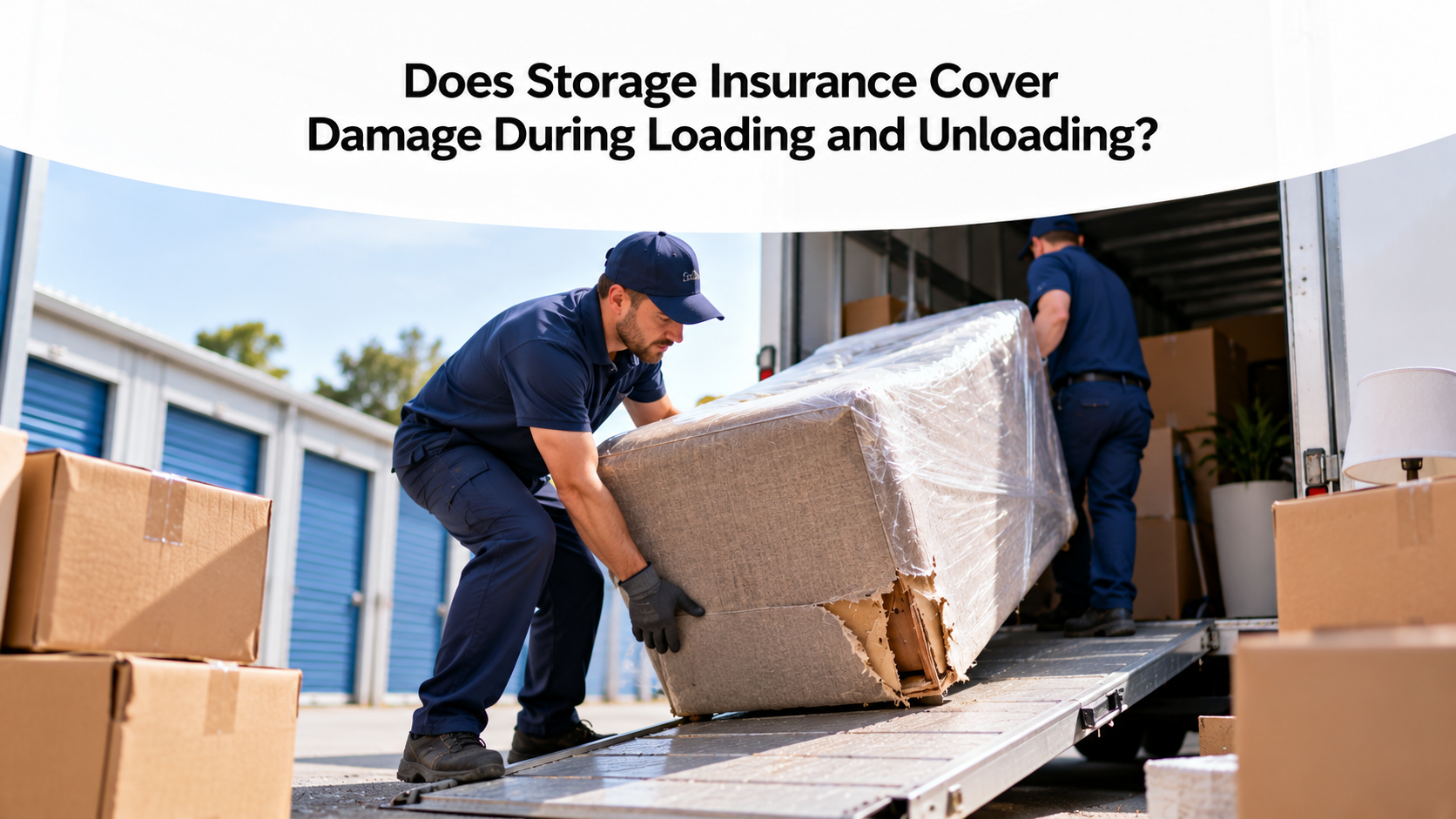
Storage insurance does not automatically cover damage that happens while belongings are being loaded into or unloaded from a storage unit. Most storage policies are designed to protect eligible property against specified events at an insured location, rather than every accident that occurs while furniture, boxes, appliances, or electronics are being handled. Whether a dropped television, scratched table, or broken appliance qualifies for coverage depends on the policy wording and the actual cause of loss.
Loading and unloading also create questions about when storage coverage begins, whether belongings are insured outside the unit, and who is responsible when professional movers cause damage. A storage policy, moving company liability arrangement, and transit insurance can provide different types of protection. Understanding these distinctions before moving day can help prevent unexpected out-of-pocket expenses.
Key Takeaways
- Storage insurance does not automatically cover accidental damage while belongings are being loaded, carried, transported, or unloaded.
- Coverage depends on the insured location, covered causes of loss, exclusions, effective dates, and any applicable handling provisions.
- Dropping furniture, breaking fragile items, or scratching appliances during handling may fall outside standard storage coverage.
- Damage caused by improper packing, unstable stacking, unsecured loads, or overloading is commonly excluded or restricted.
- Professional moving companies may provide contractual liability protection, valuation coverage, or separate insurance options.
- Portable storage container policies may address transportation and handling differently from insurance for a fixed storage unit.
- Photographs, inventories, condition reports, and moving contracts can help establish when and how damage occurred.
Pro Tip
Before moving day, confirm the exact point when your storage insurance becomes effective and whether protection applies while belongings are outside the unit. Photograph valuable furniture and electronics before anyone handles them, and ask your moving company for its written damage liability terms. Review the separate guidance on storage insurance coverage during a move to understand why protection inside a unit may differ from coverage while property is being moved.
Does Storage Insurance Cover Damage During Loading and Unloading?
Standard storage insurance generally does not provide broad accidental damage protection during loading and unloading. A policy designed for property kept inside a fixed storage unit may cover specific events at that location without extending the same protection to belongings being carried through hallways, lifted onto a truck, moved down a ramp, or unloaded at another property.
For example, a television damaged by a qualifying fire inside an insured storage unit presents a different claim from the same television falling off a moving dolly during unloading. In the second situation, the damage results from handling rather than necessarily from an event covered by storage insurance.
Some policies may contain limited provisions for property temporarily outside the unit, while specialized moving or portable container insurance may address additional stages of transportation. However, coverage for property during movement does not automatically mean accidental breakage is insured. The contract must cover both the relevant location or activity and the actual cause of damage.
Why Loading and Unloading Damage May Be Excluded
The main issue is that handling damage can occur outside the circumstances covered by a storage contents policy. Storage insurance generally identifies an insured location and a defined set of covered causes of loss. Loading and unloading introduce additional risks involving manual handling, packing methods, equipment, transportation, and the actions of other people.
An item may be eligible personal property but still be damaged by an excluded cause. Dropping a box, striking a doorway with furniture, crushing fragile belongings under heavier objects, or allowing unsecured items to fall may not trigger the same protection as a covered fire or burglary.
This distinction is explained further in the guide to storage insurance exclusions. Insurance eligibility depends on what caused the loss, not simply whether the damaged belongings were intended to be stored in an insured unit.
Loading and Unloading Damage: Coverage at a Glance
| Damage Scenario |
Potential Coverage |
Important Consideration |
| Furniture dropped while loading |
Usually not covered by standard storage insurance. |
May require separate handling protection or mover liability coverage. |
| Glassware broken inside a moving box |
Commonly excluded when caused by poor packing or handling. |
The cause and packaging condition matter. |
| Appliance scratched during unloading |
Generally not automatically covered. |
Check moving company damage provisions. |
| Belongings damaged in a moving truck accident |
May require transit coverage or an applicable mover protection arrangement. |
Fixed-location storage insurance may not extend to transportation. |
| Contents damaged by a covered fire inside the unit |
Potentially covered. |
Subject to eligibility, exclusions, limits, and deductibles. |
| Property damaged while a portable container is transported |
Depends on portable storage and transit terms. |
Transportation coverage may still exclude shifting or poor packing. |
When Does Storage Insurance Coverage Begin?
Coverage generally begins according to the effective date, time, insured location, and other conditions stated in the policy. A policy purchased for a particular storage unit should not automatically be interpreted as covering belongings at home, in a parking lot, inside a moving truck, or along the route to the facility.
For example, purchasing storage insurance on Monday does not necessarily mean furniture is protected against accidental damage while being carried from your home on Tuesday. The policy may insure qualifying property only within the specified storage arrangement and for particular causes of loss.
Before move-in, confirm the policy's effective date and ask whether protection starts when belongings enter the facility, when they are placed inside the unit, or under another defined condition. Do not assume the act of purchasing coverage automatically insures every stage of the moving process.
Does Insurance Cover Furniture Dropped During Loading?
Furniture dropped while being carried, lifted, or loaded is not necessarily covered by storage insurance. A sofa slipping off a dolly, a wooden dresser falling down a staircase, or a dining table striking the side of a truck involves accidental handling damage that may fall outside a policy intended for stationary stored belongings.
If professional movers caused the damage, their liability arrangements may be relevant. If you or someone assisting you handled the furniture, a separate accidental damage or moving insurance policy may be necessary, depending on what protection is available and its exclusions.
Take condition photographs before lifting valuable furniture, remove detachable components where appropriate, protect corners and exposed surfaces, and use equipment rated for the item's weight. These precautions reduce the likelihood of damage regardless of insurance coverage.
Are Broken Items Covered During Unloading?
Items broken during unloading may be excluded when the loss results from accidental dropping, collisions, improper handling, or inadequate packaging. This can apply to mirrors, televisions, artwork, lamps, appliances, and other fragile belongings carried from a vehicle into a storage unit.
Consider a glass tabletop that fractures after striking the concrete floor while being removed from a truck. Even if the table was intended for an insured unit, the incident occurred during handling. That fact can be important when determining whether the storage policy applies.
A sudden accident does not automatically qualify as a covered event. The insurance contract must provide protection for the particular type of accidental damage and the location or stage of movement involved.
Does Poor Packing Affect Loading and Unloading Claims?
Improper packing is one of the most significant considerations when assessing moving-related damage. Even when a policy contains certain transportation provisions, it may exclude damage resulting from inadequate cushioning, unsuitable containers, unsecured items, poor weight distribution, or shifting contents.
For example, ceramic dishes placed loosely into a cardboard box may break when the box is lifted or set down. A computer monitor packed without adequate protection can suffer screen damage without the moving vehicle ever being involved in a collision. These losses may be attributed to packing or ordinary handling rather than a qualifying insured event.
- Use appropriately sized boxes with adequate strength for their contents.
- Wrap fragile property individually and provide sufficient cushioning.
- Avoid placing heavy objects above delicate belongings.
- Secure furniture doors, drawers, and detachable parts before lifting.
- Label boxes containing fragile items and communicate handling requirements.
- Use suitable straps, dollies, padding, and protective covers.
Does Storage Insurance Cover Damage Caused by Movers?
A moving company damaging your belongings does not automatically make the loss payable under your storage insurance. Responsibility may instead depend on the moving company's contract, applicable transportation rules, liability provisions, and any additional protection you selected.
For qualifying interstate household moves in the United States, federal rules generally require movers to offer liability options, including Full Value Protection and Released Value Protection. These options are not identical to ordinary property insurance. Released Value Protection provides limited liability based on shipment weight, while Full Value Protection generally provides broader responsibility for qualifying lost or damaged items, subject to its terms and exceptions.
Local and intrastate moves may be governed by different state requirements. Before hiring movers, ask for a written explanation of the protection being offered, applicable limits, deductibles, exclusions, and procedures for reporting damage. Do not assume that a moving company being licensed or insured means your belongings are protected against every type of breakage.
Storage Insurance vs. Moving Insurance vs. Mover Liability
These arrangements address different exposures. Storage insurance primarily concerns qualifying property at an insured storage location. Moving insurance may address defined risks while belongings are transported or handled. Mover liability describes the responsibility a moving company accepts or is legally required to provide under the applicable moving arrangement.
| Protection Type |
Primary Purpose |
Loading and Unloading Considerations |
| Storage Unit Insurance |
Protect eligible belongings against specified risks associated with insured storage. |
Accidental handling damage is not automatically included. |
| Moving or Transit Insurance |
Protect property against defined risks during transportation or a move. |
May include handling when expressly covered; exclusions still apply. |
| Mover Liability or Valuation |
Establish the mover's responsibility for qualifying lost or damaged belongings. |
Depends on the applicable liability option, contract, and law. |
| Portable Storage Coverage |
May address property stored in a movable container during specified stages. |
Check pickup, transportation, delivery, packing, and handling provisions. |
Are DIY Moves Covered by Storage Insurance?
Moving belongings yourself does not automatically extend storage insurance to loading and unloading. If you rent a truck, use a personal vehicle, or ask friends to help, the storage policy may still apply only to qualifying events at the designated insured location.
A rental truck agreement may offer certain protection options, but vehicle damage waivers and liability products are not necessarily insurance for the cargo inside the truck. Similarly, personal auto insurance may not protect ordinary household belongings against handling damage during a move.
Check the rental company's cargo protection terms and any available moving insurance separately. Pay attention to exclusions for customer loading, fragile items, inadequate packing, theft, and damage caused by shifting loads.
Are Belongings Covered While Inside a Moving Truck?
A moving truck is not automatically considered part of the insured storage location. A policy covering items inside a fixed self-storage unit may provide no protection while the same belongings are traveling in a rental truck, personal vehicle, or commercial moving vehicle.
Transportation introduces risks such as collisions, sudden braking, shifting cargo, theft from vehicles, and unloading accidents. The availability of protection depends on the applicable transportation coverage, mover liability provisions, and circumstances of the incident.
Before transporting insured belongings, confirm whether the policy follows the property during transit. If it does not, consider appropriate separate coverage for the moving period rather than assuming protection at the departure and destination facilities also applies to the journey.
Does Portable Storage Insurance Cover Loading and Unloading?
Portable storage containers create different coverage questions because the container may be delivered to a home, loaded by the customer, transported by a provider, stored at a facility, and delivered again. Insurance designed for these arrangements may apply during more than one stage, but the covered events and exclusions must still be examined.
For example, a policy may address specified risks during transportation without covering a television damaged because it was inadequately secured inside the container. Protection against certain transit events does not necessarily include ordinary handling breakage or movement-related scratches.
Review the guidance on keeping storage insurance active while a container is in transit to understand why pickup dates, delivery arrangements, container details, and coverage terms are important.
What Happens When You Move Belongings Between Storage Units?
Changing storage units can affect insurance because coverage may identify a particular address, facility, unit number, or storage arrangement. If belongings are moved to a different location without updating the policy when required, the insured location information may no longer match where the property is kept.
Even when the old and new units are both eligible for insurance, there may be a separate exposure during transportation. The policy should be checked for requirements concerning location changes, effective dates, temporary moves, and the transfer of insured contents.
Follow the appropriate process for transferring storage insurance when changing units before relocating belongings. Updating the storage address does not necessarily provide coverage for accidental loading, unloading, or transportation damage.
Can Damage Occurring Inside the Storage Unit Be Covered?
Being physically inside the insured unit does not automatically mean every type of damage qualifies for reimbursement. The cause of loss remains important. For example, a storage policy may cover qualifying damage from a specified fire or vandalism event while excluding damage caused by a customer accidentally dropping an appliance while rearranging the unit.
Likewise, a box falling because it was placed on an unstable stack may be treated differently from damage caused by an insured falling object. The policy's definitions and covered causes of loss determine whether a particular incident qualifies.
Understanding what storage unit insurance covers helps distinguish insured events from ordinary accidents involving property handling, packing, and stacking.
Who Is Responsible if Furniture Is Damaged During a Move?
Responsibility depends on who was handling the furniture, the applicable contract, the cause of damage, and any insurance or liability protection in effect. The storage facility, moving company, truck rental company, and property owner do not automatically share responsibility for the same incident.
If professional movers cause damage during a service covered by their agreement, the mover's liability provisions may apply. If a customer damages their own belongings while loading, that loss may remain the customer's responsibility unless another policy specifically covers it.
If damage results from a defective facility feature, such as a malfunctioning loading mechanism, responsibility may require evaluation of maintenance records, facility conditions, contractual terms, and applicable law. A facility is not automatically liable merely because an accident occurred on its property.
Does Storage Insurance Cover Loading Dock or Elevator Accidents?
Accidents involving storage facility loading docks, elevators, ramps, carts, and doorways can create questions about both insurance and responsibility. A box falling from a cart or furniture striking an elevator door may be considered handling damage rather than a covered storage event.
When equipment failure, a damaged ramp, or another facility condition contributes to an incident, liability depends on the circumstances and applicable law. The mere presence of a storage facility's equipment does not guarantee that storage contents insurance will pay for the loss.
Report the incident promptly and preserve photographs of the equipment, surrounding area, and damaged property. Request an incident report when appropriate and retain the names or contact information of witnesses if available.
What Should You Do if Belongings Are Damaged During Loading?
When belongings are damaged, documenting the incident early can help establish what occurred, who was involved, and whether a relevant policy or moving agreement may apply. Avoid assuming that all damage is automatically covered or excluded before reviewing the circumstances.
Photograph the Damage Immediately
Take clear photographs of broken furniture, damaged electronics, torn packaging, cracked surfaces, and surrounding conditions. Include wider images showing where the accident occurred. If possible, retain photographs showing the item's condition before handling began.
Record When and How the Incident Occurred
Write down the date, location, people involved, and sequence of events. Note whether the damage occurred while the item was being carried, lifted, loaded, transported, or unloaded. These details can help distinguish handling damage from an event covered under an insurance policy.
Notify the Appropriate Company
If movers were involved, notify the moving company and follow its written claim procedures. Contact the storage insurer if the loss may involve an insured event. If storage facility equipment or conditions contributed to the incident, report it to facility management as well.
Preserve Receipts and Damaged Packaging
Keep receipts, photographs, moving documents, inventory lists, and damaged packing materials where practical. Before repairing or disposing of an item, ask whether an inspection or additional documentation is required. Follow any applicable safety precautions when handling broken glass or damaged electrical equipment.
What Evidence Is Needed for a Loading Damage Claim?
A loading or unloading claim may require proof that the damaged property belonged to you, evidence of its condition before the incident, documentation of the damage, and information establishing when and how the loss occurred. Additional records may be necessary when professional movers, a portable container provider, or rental equipment is involved.
| Documentation |
Why It Matters |
| Before-and-After Photographs |
Help establish the item's condition before handling and the damage discovered afterward. |
| Purchase Records |
Support ownership, identification, purchase date, and original cost. |
| Moving Contract |
Identifies services, liability terms, selected protection, and claim requirements. |
| Inventory or Condition Report |
Records the property moved and any previously documented damage. |
| Incident Report |
Documents the reported circumstances, location, and people involved. |
| Repair or Replacement Estimate |
Helps assess the potential cost of restoring or replacing damaged property. |
If original receipts are unavailable, other records may help establish ownership. Photographs, serial numbers, purchase confirmations, warranty registrations, and inventory records can support the documentation process. Review the guide on proof of ownership for storage insurance claims when organizing your records.
Can You File a Storage Insurance Claim for Handling Damage?
You can contact your insurer to report an incident and request a coverage determination, but a claim involving loading or unloading damage will only qualify for payment when the applicable policy covers the circumstances. Reporting a loss does not establish that it is insured.
The insurer may examine the cause of damage, insured location, policy dates, property eligibility, exclusions, deductible, and supporting evidence. If the loss is excluded because it occurred during handling or resulted from inadequate packing, the claim may not be payable.
Understanding how storage insurance claims work can help you prepare documentation, report accurate details, and understand why an insurer may request additional information before reaching a decision.
Why Loading and Unloading Insurance Claims Can Be Denied
A claim may be denied when the reported damage falls outside the policy's covered events, insured location, or conditions. Even if the belongings were intended for a covered storage unit, the circumstances of the accident may not satisfy the requirements for reimbursement.
- The damage occurred outside the location or period covered by the policy.
- Accidental dropping or handling damage is not a covered cause of loss.
- The damage resulted from inadequate packing, unsecured contents, or unstable loading.
- The policy excludes or restricts the particular type of property.
- The reported incident occurred before the applicable coverage became effective.
- Available evidence does not establish a qualifying covered event or the reported value of the property.
A denial should be reviewed against the exact policy provision cited by the insurer. Additional records may help resolve a factual disagreement, but documentation cannot create coverage where a valid exclusion applies. If the decision appears inconsistent with the policy, ask about the insurer's available review or reconsideration procedures.
How to Prevent Damage When Loading a Storage Unit
Because ordinary handling damage may not be covered by storage insurance, safe moving practices are essential. Planning the loading sequence, choosing suitable equipment, and protecting fragile items can significantly reduce the risk of avoidable damage.
Use Proper Moving Equipment
Use furniture dollies, hand trucks, lifting straps, and other equipment suitable for the item's weight and dimensions. Check that moving equipment is in good condition and avoid exceeding manufacturer-rated capacities. Large or unusually heavy items may require professional handling.
Protect Fragile and High-Value Belongings
Use suitable cartons, padding, corner protectors, and original packaging where available. Keep mirrors, screens, glassware, and delicate electronic equipment appropriately supported. Follow manufacturer guidance for transporting appliances, televisions, and other sensitive equipment.
Load Heavy Items First
Plan the arrangement so heavy and sturdy objects form a stable foundation, while lighter and fragile belongings remain protected. Do not place excessive weight on upholstered furniture, electronics, or containers that could collapse under pressure.
Secure Items During Transportation
Where appropriate, use suitable tie-downs and load restraints to reduce shifting during the journey. Avoid leaving large gaps around heavy furniture or stacking unsecured objects that could fall during turns and braking.
Inspect Belongings During Unloading
Check vulnerable items as they are unloaded and record any visible damage promptly. If professional movers are present, identify concerns before the crew leaves and follow the company's written reporting procedures. Some damage may not be visible until items are unpacked, so retain relevant records and packaging.
How to Avoid Gaps in Insurance Coverage During a Move
Moving belongings into or out of storage can involve several distinct stages. Property may be kept at home, loaded into a vehicle, transported, placed temporarily in a loading area, and then moved into the insured unit. Different policies or liability arrangements may apply at different points.
- Confirm when your storage policy begins and which location is insured.
- Ask whether belongings are covered during loading and unloading.
- Verify whether transportation, vehicle accidents, and cargo damage require separate insurance.
- Read moving company liability and valuation terms before signing.
- Check coverage limits and exclusions for fragile or valuable belongings.
- Update the insured storage location when changing units or facilities, if required.
- Keep photographs, inventories, receipts, and moving documents accessible outside the storage unit.
What to Review Before Buying Storage Insurance
Storage insurance should be evaluated based on covered causes of loss, exclusions, insured location, property eligibility, coverage limits, deductibles, and policy conditions. The price of a policy alone does not establish whether it protects belongings during a move.
If loading and unloading are important concerns, ask the insurer directly whether accidental handling damage is covered. Request clarification about temporary removal, transportation, portable containers, professional movers, and changes to the insured unit. If these risks are not covered, consider whether separate moving protection is appropriate.
The guide to choosing the right storage unit insurance explains how to compare limits, exclusions, and coverage needs before selecting a policy.
Storage Insurance Still Protects Against Important Risks
Exclusions involving loading and unloading do not make storage insurance unnecessary. They identify circumstances where a different type of protection may be required. A dedicated storage policy can still help protect eligible belongings from specified insured events while they are kept at an insured storage location.
Depending on the contract, covered events may include qualifying fire, smoke, burglary, vandalism, lightning, and certain other risks. A dedicated storage unit insurance policy should be compared based on its actual terms rather than assuming it includes every accident associated with stored belongings.
Discount Storage Insurance offers coverage options for qualifying storage arrangements. Review the applicable insurance documents to understand which events are covered, where protection applies, and whether additional arrangements are needed for transportation or handling risks.
Conclusion: Check Coverage Before Loading and Unloading
Storage insurance generally does not automatically cover belongings that are dropped, scratched, broken, or otherwise damaged during loading and unloading. These incidents may fall outside standard coverage because of the insured location, excluded causes of loss, handling provisions, or poor packing restrictions. Separate moving insurance or mover liability protection may apply in some circumstances.
Before moving day, review your policy, confirm when and where coverage applies, and understand any protection provided by the moving company or container provider. Proper packing, careful handling, and accurate documentation can reduce damage risks and help avoid misunderstandings about which insurance arrangement may respond if something goes wrong.
Frequently Asked Questions
Does Storage Unit Insurance Cover Items Broken During Loading?
Usually not under standard storage insurance. Accidental dropping, improper handling, and breakage during loading may fall outside covered events or insured locations. Review the policy for any specific handling protection or applicable exceptions.
Does Storage Insurance Cover Furniture Dropped While Unloading?
Furniture dropped during unloading is generally not automatically covered by storage insurance. The loss may require separate moving protection or an applicable mover liability arrangement, depending on who handled the furniture and the contractual terms.
Are Items Covered While Being Moved Into a Storage Unit?
Not necessarily. Coverage depends on when the policy becomes effective, where the belongings are located, and which causes of loss are covered. Purchasing storage insurance does not automatically insure every stage of moving property into the unit.
Does Storage Insurance Cover Damage Caused by Professional Movers?
Not automatically. Damage caused by professional movers may fall under the moving company's liability provisions or separate protection rather than storage contents insurance. Review the mover's contract and applicable coverage or valuation terms.
Does Insurance Cover a Television Broken During Unloading?
A television damaged by dropping, mishandling, or inadequate packaging during unloading may not be covered by standard storage insurance. Coverage depends on the actual cause of loss and whether a relevant moving or accidental damage policy applies.
Does Storage Insurance Cover Accidental Damage Inside the Unit?
Not every accident inside a storage unit qualifies for coverage. A policy may protect property against specified events but exclude items damaged through dropping, unstable stacking, improper packing, or other forms of ordinary handling.
Does Storage Insurance Cover Damage in a Moving Truck?
Coverage for property inside a moving truck is not automatically included in fixed-location storage insurance. Transportation risks may require separate transit insurance, cargo protection, or a moving company liability arrangement.
Who Pays if Movers Damage My Belongings?
Payment depends on the moving company's contractual and legal responsibility, the selected liability protection, and the circumstances of the damage. Any applicable exclusions, limits, and claims requirements can affect reimbursement.
Does Renters Insurance Cover Loading and Unloading Damage?
Renters insurance may provide some off-premises personal property coverage, but ordinary handling damage is not automatically insured. The policy's covered causes of loss, exclusions, and off-premises limits determine whether a particular incident qualifies.
Does Portable Storage Insurance Include Loading and Unloading?
Some portable storage arrangements provide protection during specified transportation stages, but this does not guarantee coverage for accidental handling damage. Check the policy for loading, unloading, transit, packing, and shifting-content exclusions.
Can Poor Packing Cause a Storage Insurance Claim to Be Denied?
Yes. Damage caused by inadequate cushioning, overloading, unstable stacking, or improperly secured property may be excluded. The insurer examines the reported cause of loss against the specific policy provisions.
Can I File a Claim for Damage During Loading or Unloading?
You can report the incident to the relevant insurer or moving company, but reimbursement depends on the applicable coverage or liability terms. Document the damage, preserve receipts and photographs, and follow the required reporting procedures.
What Happens if Damage Is Discovered After the Movers Leave?
Photograph the damage promptly, retain packaging, check the moving inventory, and notify the moving company according to its procedures. Hidden damage may still be reportable, but applicable deadlines and documentation requirements vary. Do not assume that a delayed discovery automatically establishes or eliminates liability.
How Can I Protect My Belongings During Loading and Unloading?
Use suitable protective packing, secure heavy items, choose appropriate moving equipment, document valuables before handling, and check available insurance or mover liability protection before the move. These measures can reduce preventable damage and clarify your options if an incident occurs.